
Introduction
Influencer marketing helps businesses connect with people who can introduce their products to a wider audience. Instead of relying only on traditional advertisements, brands can work with bloggers, product reviewers, and social media creators to share useful content. This is where platforms such as Tomoson come into the picture. If you are wondering how Tomoson works, the basic idea is to help brands and content creators connect through promotional campaigns and manage their collaboration.
Tomoson has been associated with influencer discovery, product promotions, sponsored content, and product review campaigns. Brands can use this type of service to find suitable creators, while influencers may discover opportunities to work with businesses and introduce products to their followers. However, the available features, campaign types, and account requirements can change over time.
In this guide, you will learn how Tomoson works, how brands and influencers can use it, what its potential costs and benefits are, and what limitations to consider. You will also learn how to check its current availability and compare it with other influencer-marketing options before deciding whether it meets your needs.
What Is Tomoson?
Tomoson is a name associated with influencer marketing services that help businesses connect with bloggers, reviewers, and social media creators. These collaborations can involve product promotions, sponsored posts, product demonstrations, and other forms of online content. The main idea is to make it easier for businesses to reach relevant audiences through people who already create content in a particular niche.For example, a skincare company may want to introduce a new moisturizer to people interested in beauty products. Rather than depending entirely on paid advertisements, the company could work with suitable beauty creators who can explain the product and share their experiences. Similarly, a kitchenware brand might seek food bloggers who can demonstrate how to use its products in everyday cooking.
Influencer marketing differs from traditional advertising because creators communicate with their own audiences through their usual content channels. Their followers may value their recommendations, although trust and engagement vary from one creator to another.A platform like Tomoson can help organize the process of finding partners, discussing campaign requirements, and managing content deliverables. It may be useful for small businesses, established brands, bloggers, and creators who want to explore promotional partnerships. However, users should confirm which services are currently available instead of assuming every previously advertised feature still operates.
How Does Tomoson Work Step by Step?
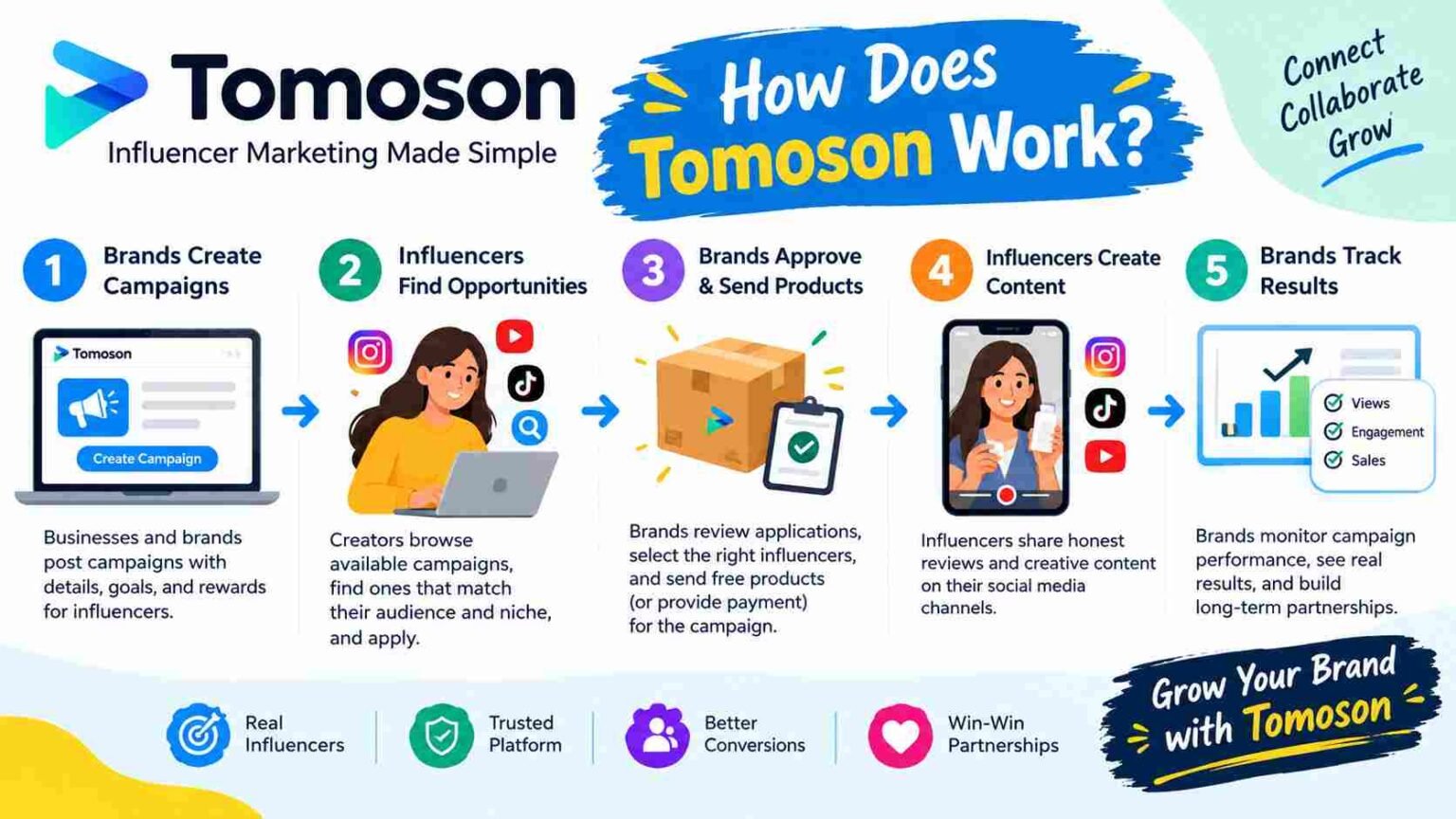
Understanding how Tomoson works becomes easier when you look at the process from beginning to end. The basic model involves brands offering campaigns, creators applying for suitable opportunities, and both sides completing agreed tasks. The exact process may depend on the campaign and the platform’s current features.
Step 1 — Create a Brand or Influencer Profile
A business or creator begins by setting up an account, if registration is available. Brands may need to provide product information, business details, and campaign goals. Influencers should present their niche, content channels, audience information, and examples of their work. Accurate details help both sides decide whether a partnership is suitable.
Step 2 — Create or Browse Campaigns
A brand prepares a campaign describing its product, intended audience, required content, deadline, and compensation. Influencers browse available offers and look for products that match their interests and followers. Clear campaign instructions help prevent confusion later.
Step 3 — Apply for Campaigns or Select Influencers
Creators apply to campaigns that fit their experience and audience. Brands then review applications and consider factors such as content quality, audience relevance, and engagement. Tomoson’s published influencer FAQ describes a process in which brands set eligibility requirements and manually approve their preferred applicants.
Step 4 — Receive Products or Agree on Compensation
Once selected, the influencer checks the campaign terms. Some offers may involve free products, while others may provide discounts or payment. Shipping arrangements and deadlines should be clear before the creator accepts the offer.
Step 5 — Create and Publish Content
The creator tests the product and prepares the agreed content. Depending on the campaign, this could be a blog article, product demonstration, review, or social media post. Content should be original and reflect the creator’s honest experience.
Step 6 — Submit Proof and Complete the Campaign
The influencer provides the required links or other evidence of completion. The brand checks whether the content meets the agreed requirements and follows up if something is missing.
Step 7 — Review Performance and Results
Finally, the brand examines engagement, traffic, conversions, and content quality. These results help determine whether the collaboration achieved its goals and whether a future partnership would be worthwhile.
How Does Tomoson Work for Brands?
For businesses, Tomoson is associated with making influencer discovery and campaign management more organized. Instead of contacting every blogger or creator individually, a business can use a suitable marketplace to identify potential partners and communicate its requirements. This can be helpful for smaller companies that do not have a dedicated marketing team.The first step is to decide what the campaign should achieve. A company might want to introduce a new product, increase awareness, encourage people to visit its website, or collect useful user-generated content. Each goal requires a different approach. For example, a campaign designed to increase website visits should focus on trackable links, while a product-awareness campaign may prioritize relevant content and audience reach.
Next, the brand should create a clear brief that explains the product, target audience, deliverables, timeline, and available budget. It can then evaluate suitable creators and select those whose content matches its brand. After the product is delivered and the creator completes the agreed work, the business reviews the results.Brands should remember that influencer marketing requires planning. A large follower count does not automatically lead to sales, and a creator with a smaller, relevant audience may be a better match. Current subscription costs, product expenses, shipping fees, and creator compensation should all be included in the campaign budget.
How Does Tomoson Work for Influencers?
For influencers, Tomoson has been associated with finding product promotions and brand collaboration opportunities. These opportunities may appeal to bloggers, reviewers, and social media creators who want to work with businesses related to their content. However, available campaigns and eligibility requirements should be checked before joining.
An influencer should begin by presenting a clear profile. It should explain the creator’s niche, the type of content they publish, and the audience they reach. A food blogger, for example, might focus on kitchen equipment, cooking ingredients, or food-related products. Relevant content samples help brands understand what the creator can offer.When applying for a campaign, the influencer should read the requirements carefully. A free product is not necessarily the same as paid work, and each offer may have different deadlines, posting rules, and deliverables. Creators should also confirm whether they must publish a review, create social content, or simply test a product.
Professional communication is equally important. Influencers should complete accepted tasks on time, provide working links, and contact the brand if a problem arises. Tomoson’s published FAQ specifically emphasizes timely completion, original content, and professional conduct.Building a good reputation takes consistency. Honest opinions, clear disclosures, and reliable communication can help creators develop stronger relationships with brands, whether they use Tomoson or another service.
What Are the Main Features of Tomoson?
Tomoson has been associated with several tools designed to support influencer campaigns. One central concept is campaign management: brands describe a promotional opportunity, specify what they need, and review creators who express interest. This structure can make collaborations easier to organize than scattered email conversations.
Influencer discovery is another important part of the model. Businesses need creators whose content and audiences fit their products. Profiles and eligibility criteria can help brands evaluate potential partners, although businesses should still check engagement quality and content relevance instead of relying only on follower counts.Communication and task tracking also matter. Campaign messages can help clarify product delivery, deadlines, and posting requirements. Once content is published, creators may need to submit links or other evidence so brands can confirm that the agreed work is complete.
Some campaign processes may also include performance records or basic reporting. However, readers should not assume that Tomoson currently provides every advanced analytics feature offered by newer marketing platforms. Detailed sales attribution, audience research, and conversion analysis may require separate tools.The practical value of these features depends on availability and execution. Before signing up, users should confirm which tools are currently accessible, what each plan includes and whether the service supports the channels they use. A platform is useful when its features solve a real problem, not simply because it offers a long list of tools.
Does Tomoson Offer Free Products or Paid Campaigns?
Tomoson has historically supported product promotions in which creators receive products for free or at a discount. Its published influencer FAQ says that most products offered through the platform are provided at no charge, while some are discounted. The individual campaign explains how the product is supplied.Free products can be useful for creators who want to try items relevant to their audience. However, receiving a product does not automatically mean a creator will earn money. Paid collaborations are a separate arrangement, and payment terms should be confirmed before work begins.
Some marketing partnerships may also use affiliate commissions, where a creator earns money from qualifying sales. Do not assume this option is included in every Tomoson campaign; check the specific offer and current platform terms.Both brands and influencers should understand the full arrangement. Brands need to budget for products, shipping, platform fees, and any agreed creator payments. Influencers should consider the time required to test a product, prepare content, and meet the deadline.
Honest reviews are important, too. A brand should not demand a positive opinion in exchange for a product. Creators should explain material connections, including when they received an item for free or at a discount, according to the rules that apply to their location and publishing channel.
How Much Does Tomoson Cost?
Tomoson’s costs can depend on the user’s role and the pricing terms currently offered. The platform’s published brand FAQ describes a free trial followed by a monthly subscription fee based on software usage. It also advises brands to account for product costs, shipping, and payments to influencers.
For influencers, the published FAQ states that using Tomoson is free. However, users should confirm that this policy remains applicable to the current service and their intended activities before registering.A brand’s total spending may include several parts: the platform subscription, the cost of products sent to creators, delivery expenses, and any agreed fees for content creation. A campaign that appears inexpensive at first may require a larger budget once all these costs are included.
Rather than choosing a service based only on its monthly price, compare its available features with your actual needs. A small business running a single product campaign may need different tools from a company managing many creators across several social networks.Because prices and subscription terms can change, check the official Tomoson brand FAQ before making a payment. Do not rely on old screenshots or third-party articles for current prices.
What Are the Benefits of Using Tomoson?
One potential benefit of Tomoson is a more organized way to connect businesses with creators. Finding suitable bloggers and influencers independently can take time, particularly when a company is new to influencer marketing. A marketplace approach can help narrow the search to people who are interested in relevant products and campaigns.
Another advantage is the opportunity to create content that shows a product in real-life use. A demonstration, tutorial, or detailed review may answer questions that a traditional advertisement does not address. Brands may also gain reusable content, provided they obtain the necessary permissions and agree on how it can be used.Creators can benefit by discovering products and businesses related to their interests. Suitable collaborations may help them build a portfolio, gain experience, and develop professional relationships.
Campaign instructions and completion records can also make it easier to manage deadlines and deliverables. This is especially useful when a business works with several creators at once.Still, the benefits depend on the quality of the partnership. A relevant creator, a useful product, and clear expectations are more valuable than simply running a large number of campaigns. Tomoson or any similar platform should be treated as a tool that supports marketing work, not as a guarantee of growth.
What Are the Limitations of Tomoson?
Tomoson may simplify some parts of influencer marketing, but it cannot remove every challenge. The first limitation is creator fit. An influencer may have a large audience but very little connection to the product being promoted. If followers are not interested in the subject, the campaign may receive limited engagement.
Another issue is the work involved in managing campaigns. Brands still need to prepare product information, send samples, answer questions, review content, and evaluate results. Influencers must also spend time testing products and creating content. These responsibilities can become demanding when several campaigns run at once.Measuring sales can be difficult as well. Likes and comments show some forms of engagement, but they do not prove that a campaign generated revenue. Brands may need tracking links, discount codes, or website analytics to understand whether the campaign led to purchases.
Availability is another consideration. Online services can change their features, pricing, and registration rules. Older guides may describe tools that are no longer offered or that work differently today.Finally, no platform can guarantee positive reviews, viral content, or increased sales. Businesses should set realistic expectations and evaluate campaign results rather than assuming every collaboration will succeed.
Is Tomoson Legitimate and Safe to Use?
Tomoson has an official website and published terms, FAQs and campaign policies. These provide useful information about how the service describes its operations and the responsibilities of users. However, the existence of an official website does not guarantee that every campaign is trustworthy or that every feature is currently available.
Before registering, visit the official website and check whether account creation and the services you need are working. Read the current terms, privacy policy, and payment conditions. Be cautious if someone asks for your password, requests unnecessary sensitive information, or offers a deal that seems too good to be true.Influencers should confirm what a campaign requires before accepting a product. Brands should verify creator profiles and agree on deliverables, deadlines, and content permissions. Keep records of important agreements and use the platform’s supported communication methods when available.
Transparency is especially important for product reviews. Creators should disclose free products, payments, or other material connections where required. They should also give honest opinions rather than promising favorable reviews.The best approach is to evaluate Tomoson based on its current services, written policies, and the specific campaign involved. Do not confuse a legitimate business with a guarantee of successful results.
How Can Brands Measure Thompson Campaign Results?
Brands need clear measurements to understand whether an influencer campaign is worth the investment. The right metrics depend on the original goal. If the aim is to increase awareness, reach and relevant audience engagement may be useful. If the goal is to generate sales, clicks and completed purchases matter more.
For website traffic, businesses can use trackable links with UTM parameters to identify visits from particular creators. Unique discount codes can also help connect qualifying purchases with a campaign. Website analytics may then show whether those visitors explored products, signed up, or completed orders.Return on investment (ROI) is another useful measure. Businesses should compare the value generated by a campaign with its total cost, including products, shipping, subscriptions, and creator payments. However, attribution is not always exact because customers may see content several times before purchasing.
Brands should also review content quality, audience comments, and the creator’s ability to communicate product benefits accurately. These details can reveal useful insights even when direct sales are limited.Tomoson’s available reporting tools should be verified before a campaign begins. If the platform does not provide the necessary measurements, external analytics and tracking tools can fill the gap.
Tips for Getting Better Results With Tomoson
Good planning improves the chances of a successful influencer campaign. Start by setting one clear objective, such as increasing product awareness, attracting website visitors, or generating sales. A specific goal makes it easier to select creators and judge results.
Next, focus on audience relevance rather than follower numbers alone. Review a creator’s recent content, engagement, and audience interests. A smaller creator who regularly discusses your product category may be a better choice than someone with a much larger but unrelated audience.Write a clear campaign brief that explains the product, expected content, deadlines, compensation, and any restrictions. Both sides should agree on content usage rights before publication, especially if a brand plans to reuse a creator’s video in advertisements.
Creators should accept only campaigns they can complete on time. Brands should communicate clearly and allow enough time for delivery and content production. Sponsored content and free-product reviews should include appropriate disclosures.Finally, start with a manageable campaign, record the results, and improve the next one. Testing a small number of suitable partnerships can help businesses learn what works before committing a larger budget.
Is Tomoson Still Available in 2026?
Tomoson’s website currently has published pages describing its services, including brand and influencer FAQs. These pages are useful starting points, but their presence alone does not confirm that every feature, campaign type, or registration option is operating as expected.If you want to use Tomoson in 2026, visit its official website and check whether you can register, access the relevant account features, and find current campaigns. Brands should verify subscription details before entering payment information. Influencers should confirm that suitable offers are available and review their requirements.
Pay attention to publication dates when reading online reviews. Older articles may explain how the service worked in the past without accurately describing its current condition. Even newer third-party guides should be checked against official information.If you cannot access the features you need, consider contacting the service through its official support channels or exploring another influencer-marketing option. This simple check can save time and help you avoid making plans based on outdated information.
What Are the Alternatives to Tomoson?
If Tomoson does not meet your needs, several other approaches can help you find creators and manage brand collaborations. The right choice depends on your budget, campaign size, preferred social networks, and reporting requirements.Direct outreach is one option. Businesses can identify relevant bloggers or creators, review their content, and contact them with a clear proposal. This approach gives brands more control over partner selection, although researching and contacting people can take considerable time.
Influencer-marketing platforms and creator marketplaces offer another route. Some focus on discovery, campaign management, or performance reporting, while others specialize in particular social networks. Affiliate networks may be more suitable when a business wants to reward creators based on qualifying sales.Agencies can help companies that need strategic planning and campaign management, but their services may cost more than handling outreach internally.
Before choosing an alternative, compare the total price, creator selection tools, available analytics, payment arrangements, and content rights. Check whether the service supports your target audience and campaign goals. The best alternative is not necessarily the most expensive or feature-rich one; it is the one that meets your practical needs.
Frequently Asked Questions
1. Can beginners use Tomoson without previous influencer-marketing experience?
Beginners may be able to participate if registration is available and they meet a campaign’s requirements. A focused profile, relevant content examples, and careful reading of campaign terms can help them understand what is expected.
2. Do influencers need a large following to apply?
Not necessarily. Some campaigns may prioritize a specific niche, useful content, or audience relevance rather than follower count alone. Eligibility depends on the requirements set for each campaign.
3. Can a brand require an influencer to give a positive review?
Brands should not require creators to express an opinion they do not genuinely hold. Honest feedback and appropriate disclosures help protect audience trust and support transparent marketing.
4. Can businesses reuse content created through Tomoson?
Content reuse depends on the agreement and applicable rights. Brands should clarify whether they can repost, edit or use a creator’s content in paid advertisements before the work begins.
5. What should users do if a Tomoson campaign is unavailable?
Check the official website for current information and contact the service through a verified support channel if needed. If the campaign or feature is no longer available, consider direct creator outreach or another suitable marketplace.
Conclusion
Understanding how Tomoson works helps brands and creators decide whether its campaign model suits their goals. The platform has been associated with connecting businesses and influencers, organizing product promotions, and managing content-related tasks. Brands can use influencer partnerships to reach relevant audiences, while creators may discover opportunities to work with products that fit their interests.However, successful campaigns require more than finding a partner. Clear expectations, honest content, suitable compensation, and reliable performance tracking all matter. Before joining, check Tomoson’s current availability, pricing and campaign terms through its official website.
