
Key Takeaways
- All six big US airlines now offer free Wi-Fi in some form. JetBlue is the only one that gives it to every passenger with no account.
- Delta, American and Southwest make it free for members of their loyalty programs. Joining is free and takes a couple of minutes, even on board.
- United and Alaska make it free only on planes with Starlink. On United that’s just over half of daily flights as of November 2026.
- Plane Wi-Fi is a shared public network. Check the exact network name, never give a password to get online, and turn on a VPN once you’re through the sign-in page.
Paying up to $30 to send emails at 35,000 feet is mostly over. Since late 2025, Southwest and American have joined Delta and JetBlue in giving Wi-Fi away, and United and Alaska now do the same on their new Starlink planes.
But “free” means something different on every airline. Some want a loyalty number, some only give it away on newer planes, and one still charges $8 on older jets. Here’s what each airline actually offers right now, how to connect, and what you should know before you log in.
Which airlines have free Wi-Fi? The quick answer
| Airline | Free for | Where | If it isn’t free | Typical speed |
|---|---|---|---|---|
| JetBlue | Everyone, no account | Every plane (some routes outside the continental US excepted) | Not needed | Around 20–25 Mbps |
| Delta | SkyMiles members | Nearly every flight | Paid on some regional jets and 717s | Around 50 Mbps |
| American | AAdvantage members | All narrowbodies, newer 787s, two-class regional jets | Paid on older widebodies | Around 60 Mbps |
| Southwest | Rapid Rewards members | Wi-Fi-equipped planes | $8 per device | 20–150 Mbps, varies a lot |
| United | MileagePlus members | Starlink planes only, just over half of daily flights | $8 members, $10 others on older planes | 100–250 Mbps on Starlink |
| Alaska and Hawaiian | Atmos Rewards members | Starlink planes only | $8 on older Alaska planes | Starlink speeds |
Status checked November 13, 2026. Speeds are reported figures, not guarantees, and depend on the plane, route and how many people are online.
The pattern is simple. If you fly regularly, join the loyalty program of every airline you use. It costs nothing, and it’s now the key to free Wi-Fi on five of the six.
Delta: free for SkyMiles members on nearly every flight
Delta was the first big US carrier to make Wi-Fi free at scale, and it still has the widest coverage. The service, sponsored by T-Mobile, is free for SkyMiles members on most domestic and international flights. Delta says it has fitted more than 1,200 aircraft. A few Delta Connection regional jets and the older Boeing 717s still use paid Wi-Fi, though messaging is free on every Wi-Fi flight.
How to connect: turn on Airplane Mode, switch Wi-Fi on, join the Delta network and open deltawifi.com. Log in with your SkyMiles number. You can sign up from your seat if you aren’t a member yet.
Good to know: speeds of around 50 Mbps are enough for browsing, email and standard-definition streaming. Expect buffering on a full flight.
United: fast and free, but only on Starlink planes
United has the fastest Wi-Fi in the sky when you get it. Its Starlink service is free for MileagePlus members, and speeds of 100 to 250 Mbps mean live sports and video calls actually work.
The catch is the plane. In its November 12 update, United said Starlink is on more than half of its daily flights, should reach about 64% by the end of 2026, and will be on the whole fleet by the end of 2027. On planes without it, Wi-Fi still costs about $8 for members and $10 for everyone else on domestic and short international flights. Free messaging (iMessage, WhatsApp, Google Messages) works either way.
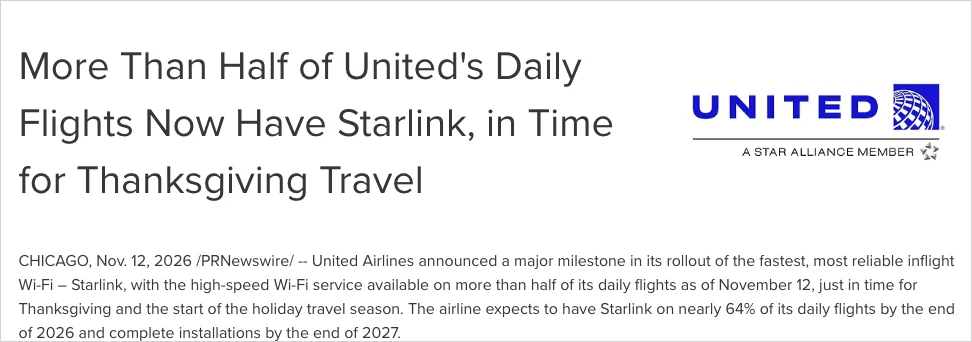
How to connect: United’s online Starlink tracker tells you whether your flight has it, up to three days before departure. United also flags Starlink flights in the app and in pre-flight emails. On board, join the United network and log in with MileagePlus.
Southwest: free for Rapid Rewards members since October 2025
Southwest teamed up with T-Mobile to make Wi-Fi free for every Rapid Rewards member starting October 24, 2025. Without membership, it’s $8 per device from takeoff to landing.
Speed is the weak spot. Most Southwest planes still use older satellite systems, and passengers report anything from 20 to 150 Mbps. Southwest’s first Starlink plane flew on June 22, 2026, and the rollout is still in its early stages.
How to connect: Airplane Mode on, Wi-Fi on, join “Southwest WiFi” and go to SouthwestWiFi.com. Add your Rapid Rewards number to your booking before you fly and it’s quicker. Download WhatsApp or iMessage updates before boarding: Southwest says the apps must be activated before you connect.
American: free for AAdvantage members since January 2026
American switched on free Wi-Fi, sponsored by AT&T, for AAdvantage members in January 2026. It covers every Airbus A319, A320, A321 and Boeing 737, all two-class American Eagle regional jets and the newer Boeing 787-8 and 787-9 aircraft. Some older widebodies on long-haul routes are still paid.
How to connect: join the American network and open aainflight.com. Log in with your AAdvantage number and password, then pick “Free Wi-Fi”. You can join AAdvantage from the same page during the flight.
Good to know: around 60 Mbps is comfortable for streaming on one device. American also streams a free film and TV library to your phone on most flights, so you don’t need the internet for entertainment.
JetBlue: the only one that’s free for everyone
JetBlue’s Fly-Fi is still the simplest deal in the US. It’s free for every passenger on every plane, and you don’t need an account. You watch a short ad from a partner and you’re online.
How to connect: join “Fly-Fi.com”, go to flyfi.com in your browser, watch the ad and log in as a guest or with TrueBlue.
Good to know: at around 20–25 Mbps it’s the slowest of the free services, fine for messages and browsing, patchy for video. JetBlue says some flights outside the continental US may have no service, with Europe and the UK as exceptions.
Alaska and Hawaiian: free on Starlink planes
Alaska and Hawaiian now share one loyalty program, Atmos Rewards. Members get free Starlink Wi-Fi, sponsored by T-Mobile, but only on planes that have it. Alaska’s whole Embraer 175 regional fleet is done, and the mainline jets should follow by 2027. On older Alaska planes, Wi-Fi costs about $8.
Two things catch people out. Hawaiian’s Wi-Fi used to be free for everyone, but since mid-2026 you need an Atmos Rewards login. And Hawaiian’s inter-island flights have no Wi-Fi at all. Passengers under 18 can connect by entering their booking details.
Is plane Wi-Fi safe?
Mostly, yes. Most of what you do online is protected by HTTPS, and many in-flight systems stop passengers’ devices from seeing each other. Security researchers interviewed by Travel + Leisure put it roughly on a par with hotel or airport Wi-Fi.
But it’s still a public network, with three risks worth knowing.
1. Fake networks on board. In 2024, Australian police charged a man who allegedly carried a portable Wi-Fi device onto domestic flights and through three airports. His fake “free Wi-Fi” networks led to sign-in pages that asked for email or social media logins. The case started when airline staff noticed a suspicious network during a flight. Use the network name on the seat-back card or in the airline’s app, not the strongest signal in the list.

2. The sign-in page knows who you are. Unlike café Wi-Fi, airline portals ask for your loyalty number, name or seat. That’s normal and needed. But it means the Wi-Fi provider can link everything your device does on that flight to you by name. The provider can’t read HTTPS pages, but without extra protection it can see which sites and apps you use.
3. Anything unencrypted is readable. Some apps still send data without encryption. On a shared network, that data can be read by whoever runs it.
The fix for the second and third points is a VPN. It wraps everything your device sends in one encrypted connection, so the in-flight provider sees a single link to a VPN server instead of your full list of sites and apps. If you fly often, it’s worth setting one up before your trip, not at the gate. Here’s how a VPN for travel works on hotel, airport and in-flight networks if you want to see the setup in detail.
Two practical notes. Log in to the airline portal first, then turn the VPN on: the portal has to load before anything else can get through. And if the VPN won’t connect, some in-flight systems block certain VPN protocols to save bandwidth. Switching to a protocol that runs over port 443 usually solves it.
How to get the best out of plane Wi-Fi
- Join every loyalty program before you fly. It’s free and turns five of six airlines’ Wi-Fi from paid to free.
- Check for Starlink on United and Alaska. If streaming or video calls matter, it’s worth picking a flight that has it.
- Download before you board. Films, playlists and work files. Even good plane Wi-Fi slows down when 150 people log in at once.
- Update apps on the ground. Messaging apps may need to be activated before you connect, and updates on plane Wi-Fi are slow.
- Turn off AirDrop and file sharing. Set AirDrop to Contacts Only or Receiving Off for the flight.
- “Forget” the network when you land. This stops your phone from joining a look-alike network with the same name at the next airport.
FAQ
Does Delta have free Wi-Fi?
Yes, for SkyMiles members on nearly every Delta flight. Joining SkyMiles is free and you can do it on board. A few regional jets and 717s still have paid Wi-Fi, and messaging is free on all Wi-Fi flights.
Is United Wi-Fi free?
Only on Starlink-equipped planes, and only for MileagePlus members. That’s just over half of United’s daily flights as of November 2026. On other planes, Wi-Fi costs about $8 for members and $10 for non-members on domestic flights.
Is Southwest Wi-Fi free?
Yes, for Rapid Rewards members on Wi-Fi-equipped planes, since October 24, 2025. Without membership it’s $8 per device.
Which airline has the best free Wi-Fi?
For access, JetBlue: free for everyone with no account. For speed, United and Alaska on Starlink planes. For coverage, Delta and American, which offer free Wi-Fi on most of their fleets.
Can I use a VPN on plane Wi-Fi?
Usually yes. Log in to the airline’s Wi-Fi page first, then connect the VPN. If it won’t connect, try a different protocol in the VPN app’s settings.
Can other passengers see what I’m doing on plane Wi-Fi?
Usually not. Most sites use HTTPS, and many in-flight systems block devices from talking to each other. The airline’s Wi-Fi provider can see which sites you visit unless you use a VPN.
