
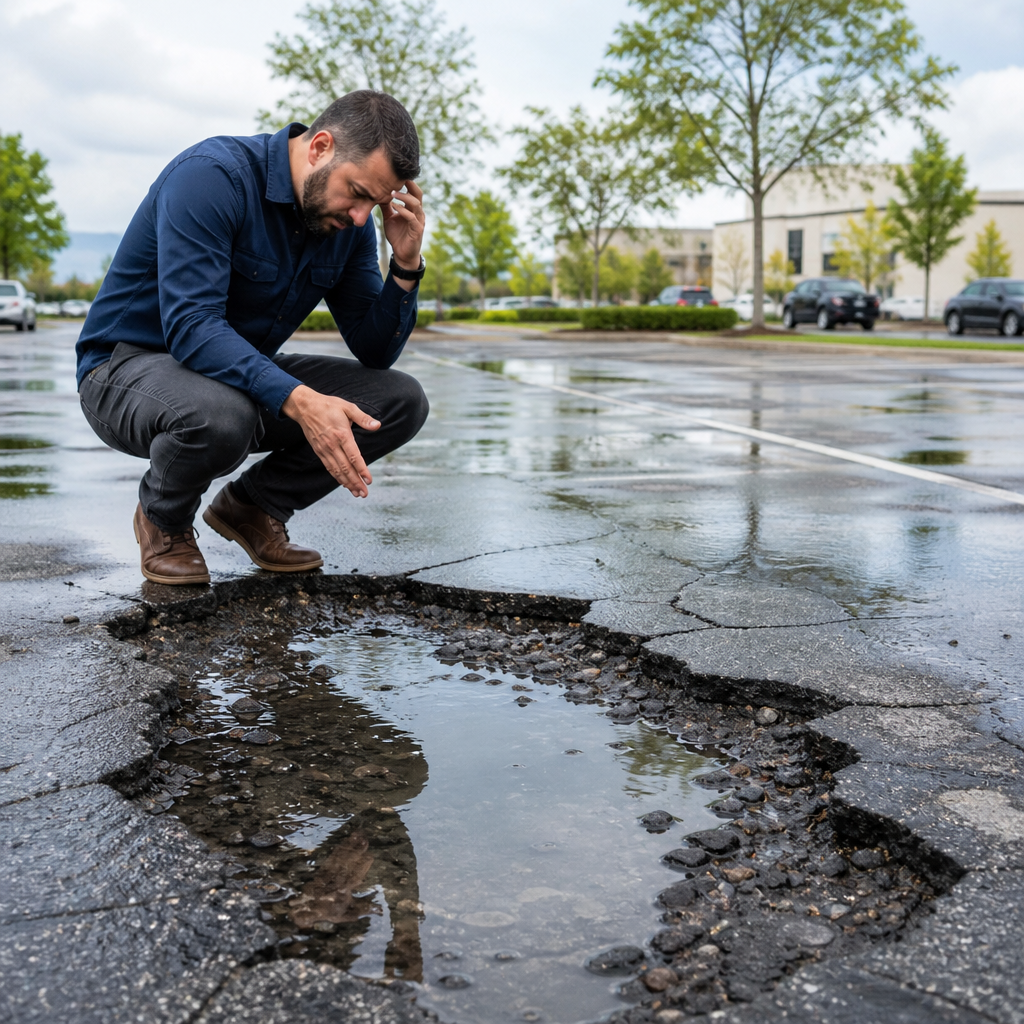
Most commercial pavement does not fail suddenly. It fails on a schedule that nobody wrote down. A hairline crack opens in year three, takes on water in year four, freezes and widens in year five, and by year seven the subgrade underneath has turned soft and the repair bill is no longer a maintenance line item — it is a capital project. For property owners and managers, the interesting question is not “how much does paving cost?” but “what am I paying every year by doing nothing?”
This is particularly sharp in climates with aggressive freeze–thaw cycling. Colorado’s Front Range is a useful case study because it combines high-altitude ultraviolet exposure, dramatic daily temperature swings, winter de-icing chemicals and summer thunderstorms. Pavement there ages faster than the same mix would in a mild maritime climate, and the gap between a maintained lot and a neglected one widens quickly.
The deterioration curve, and why it bends so sharply
Pavement engineers talk about condition in terms of a Pavement Condition Index, usually scored from 0 to 100. The important thing about the PCI curve is that it is not a straight line. An asphalt surface loses relatively little condition in its early years, then drops steeply once oxidation, cracking and water infiltration begin to work together. The practical consequence: the money you spend holding a lot in the upper band of that curve buys far more years of service than the same money spent trying to rescue a lot that has already dropped into the lower band.
Three mechanisms drive the drop:
- Oxidation. Sunlight and air strip the lighter oils out of the asphalt binder. The surface greys, loses flexibility and begins to ravel — the loose grit you sweep up in spring is literally your pavement leaving.
- Water intrusion. Once a crack reaches the base course, every rainstorm and snowmelt pumps water into the structure. Saturated base loses load-bearing capacity, and traffic does the rest.
- Freeze–thaw. Water in a crack expands as it freezes, levering the crack wider. Repeat that dozens of times a winter and a 3mm crack becomes a 20mm channel with spalled edges.
Preventive work, ranked by return
Crack sealing
If you only do one thing, do this. Hot-pour rubberised sealant routed into a cleaned crack keeps water out of the base and stays flexible enough to move with the slab through temperature cycles. It is unglamorous, it looks like black scribble for a few weeks, and it is almost always the highest-return intervention available on a commercial lot. Done annually or biennially, it quietly removes the single biggest cause of structural failure.
Sealcoating
Sealcoat is a sacrificial wear layer, not a structural repair. It will not bridge cracks or fix a failing base, and anyone selling it as a cure for alligator cracking is selling you cosmetics. What it does well is slow oxidation, resist fuel and oil spotting, and restore the dark, uniform surface that makes fresh striping read clearly. Typical reapplication intervals on commercial lots run in the two-to-four-year range depending on traffic volume, drainage and sun exposure.
Patching and full-depth repair
Where the base has failed, surface treatments are wasted money. A full-depth patch — saw-cut, excavate, correct the base, replace in compacted lifts — costs more per square foot than anything else on the menu, which is exactly why isolating and fixing these areas early matters. A dozen small full-depth patches are cheaper than one mill-and-overlay forced on you three years ahead of plan.
Striping, ADA markings and fire lanes
Layout is where maintenance meets liability. Faded accessible-stall markings, a worn access aisle or an unreadable fire lane are compliance exposures, not aesthetic ones. They are also cheap to correct when the surface underneath is sound, and awkward to correct when it is not — another argument for keeping the structure healthy.
Materials are moving faster than most maintenance plans
Mix design and treatment technology have not stood still. Warm-mix asphalt, higher recycled-content binders, polymer-modified sealants and better rejuvenator chemistry have all changed what is realistic on a commercial site, and trade coverage of recent advances in asphalt pavement materials and methods is worth skimming before you approve a multi-year programme. The practical takeaway for an owner is simple: a maintenance specification written eight years ago may be leaving options on the table, and it is reasonable to ask a contractor why they are recommending one treatment over a newer alternative.
Building a plan instead of reacting to emergencies
The difference between a reactive budget and a planned one is predictability. A condition-based plan starts with a walked assessment — segment the lot, score each section, photograph defects, map drainage — and then sequences work over three to five years so that no single year carries a shock. Drive lanes and dumpster approaches get attention before low-traffic parking bays. Drainage correction comes before resurfacing, because resurfacing over a ponding area simply buys you a new ponding area.
A workable sequence for most owners looks like this:
- Get a written condition assessment with segment-level scoring and photographs.
- Separate structural repairs from surface treatments in the scope, so you can see what you are actually buying.
- Fix drainage and failed base areas first.
- Seal cracks on a fixed annual or biennial cycle, regardless of what else is happening.
- Sealcoat and re-stripe together, so the layout work lands on a fresh surface.
- Re-score the lot every two to three years and roll the plan forward.
When it pays to bring in a specialist contractor
Once a portfolio grows beyond one or two sites, informal patching stops scaling and you need a contractor who works from condition data rather than from whatever looks worst on the day. Asphalt Coatings Company has worked on Colorado commercial pavement since 1986, using in-house crews and PCI-based pavement management to assess, repair and maintain lots across Denver, Aurora, Colorado Springs, Fort Collins and Northern Colorado, and a long list of Front Range and Western Slope communities. They are licensed and insured, use CDOT approved sealant materials, hold a 4.7/5 Google rating, and build condition-based multi-year plans rather than one-off quotes — their breakdown of the factors that drive parking lot maintenance cost in Denver is a sensible primer on what actually moves the number before you request an on-site assessment, where an estimator replies within one business day.
Questions worth asking any bidder
- Will you give me a segment-by-segment condition score, or just a price?
- Which line items are structural and which are cosmetic?
- How are you preparing cracks before sealing — routing, blowing, heating?
- What is the reapplication interval you expect, and what shortens it?
- How will phasing keep the site open for tenants and customers?
Documentation is the other half of the job. Keep the assessments, scopes, photographs and invoices in one place; they justify budget requests, support insurance and compliance questions, and give the next manager a starting point instead of a mystery. If you store that record in a members’ area or subscriber account and find yourself locked out, you can reset your account password and pick up where you left off rather than rebuilding the file from scratch.
The short version
Pavement rewards attention and punishes drift. Seal the cracks, protect the surface, fix drainage before you resurface, and keep a scored record of what you own. Owners who do those four things tend to replace their asphalt once a generation. Owners who wait for potholes tend to replace it twice — and pay for the striping, the signage and the tenant complaints both times.
