
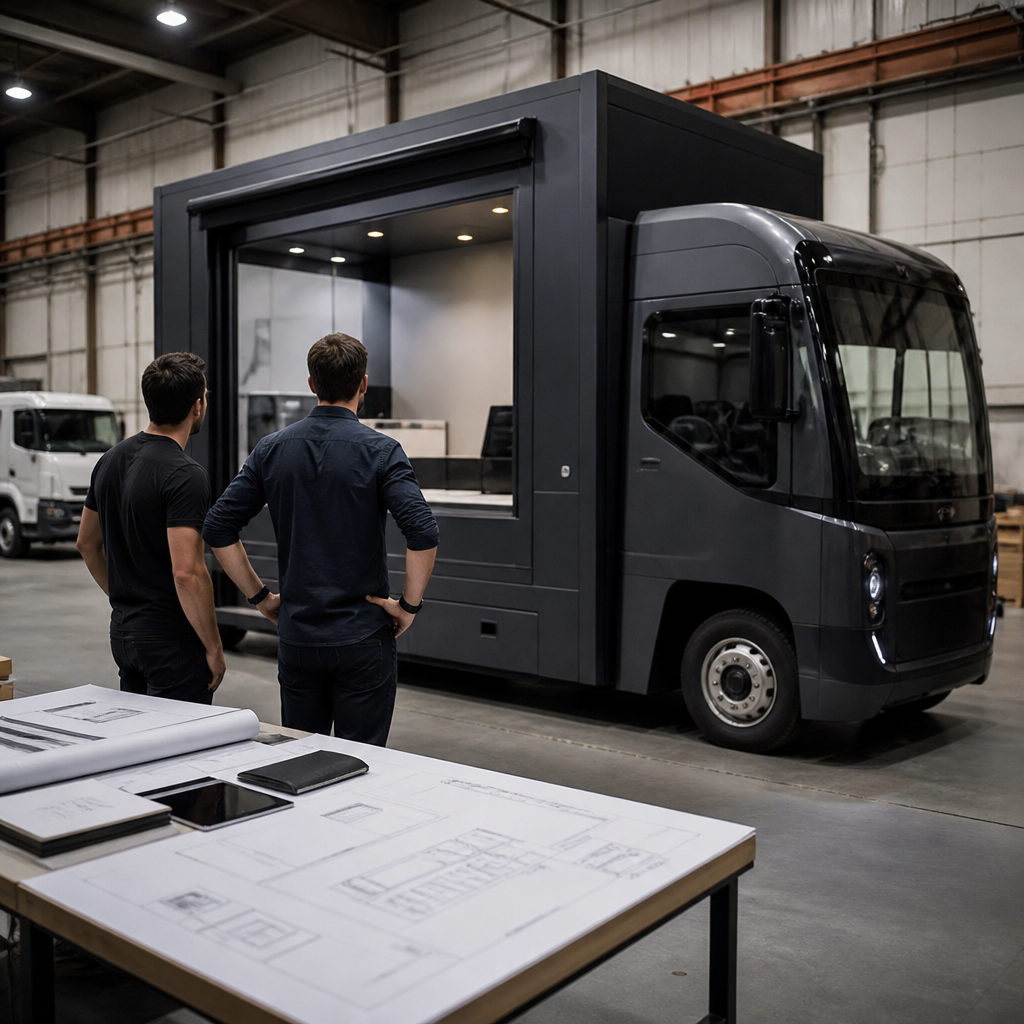
A roadshow vehicle looks like a marketing decision and behaves like an engineering one. The brief usually arrives as a mood board — a gleaming trailer, a crowd, a sampling counter — and it has to be translated into axle ratings, generator sizing, panel finishes and a load-in plan that works on a cobbled market square in March. Teams that get this translation wrong discover it late, usually at the first event, when the awning fouls a lamp post or the power draw trips a site breaker.
What follows is a practical sequence for specifying a mobile unit, written for marketers and event producers who will have to sign off the build and then live with it for three to five seasons.
Start with the tour, not the trailer
Every meaningful specification decision falls out of the itinerary. Write the tour plan first, even if it is provisional: number of activation days, hours on site, drive distances between stops, and the type of venue. A unit doing twelve high-footfall city centre days a year is a different machine from one doing ninety stops at retail car parks and county shows.
Three itinerary facts drive most of the engineering:
- Access constraints. Narrow gateways, low bridges, weight-restricted estate roads and pedestrianised zones with timed access windows will cap your overall length and height before you choose a single fixture.
- Setup window. If a venue gives you ninety minutes between arrival and doors, you need a unit that deploys with two crew and no forklift. If you have a full build day, you can afford staged assembly and separate kit.
- Dwell time per visitor. A thirty-second sampling interaction needs frontage and queue flow. A five-minute product demo needs seating, acoustic separation and climate control.
Choose the platform: trailer, box truck or coach conversion
The platform decision is the one that is most expensive to reverse, so argue about it early.
Towed trailers
Trailers give you the most usable floor area for the money and decouple the asset from the tow vehicle, which means a mechanical fault on the truck does not strand the activation. Expanding-side and drop-side trailers can roughly double presentation area on site. The trade-offs are manoeuvring (reversing into tight pitches is a skill, not a given), the need for appropriately licensed drivers, and the fact that a parked trailer still needs somewhere for the tractor unit to sit.
Box trucks and van-based builds
Self-propelled units win on urban agility and on turnaround speed — arrive, level, open, trade. They suit sampling, mobile retail and short-dwell demos. You pay for it in interior volume and in the coupling of vehicle and build: the body goes off the road whenever the chassis does.
Coach and command-style conversions
Where the unit also has to function as a working space — briefing area, control desks, crew welfare, private meeting room — a coach-style conversion earns its keep. This is the same architecture used for emergency command vehicles and production trailers, and the overlap is useful: the engineering patterns for comms, power redundancy and operator workstations are mature, and borrowing them for a brand unit tends to produce something more robust than a purely cosmetic build.
Power, HVAC and the things that ruin event days
Specify power from a measured load schedule, not a guess. List every item — LED walls, media players, fridges, coffee machines, induction hobs, task lighting, laptops, air conditioning — with its running watts and its inrush. Add a sensible margin, then decide how you will feed it: shore power where available, an onboard generator, a battery system, or a hybrid of the two. Hybrid arrangements are increasingly the default for city activations, because many venues now restrict generator running hours on noise grounds.
Three practical rules worth holding to:
- Assume shore power will be weaker and further away than promised. Carry long, correctly rated cable and the adaptors for the connector types you will actually meet.
- Size cooling for a glazed box in direct sun with twenty people inside, not for a showroom. Interiors with large screens and a service counter generate a lot of heat.
- Put the generator, pumps and compressors as far as physically possible from the guest-facing side. Noise kills conversation, and conversation is the product.
Graphics, finishes and the cost of looking new
A unit that tours hard gets scuffed at exactly the heights people photograph. Specify replaceable panels at kick height, protective film on high-touch edges, and a wrap that is designed in sections so a damaged area can be swapped without re-skinning the whole flank. If campaign messaging changes seasonally, keep the vehicle’s base livery permanent and carry the campaign on removable panels, banner frames and interior graphics.
This is where print specification deserves more attention than it usually gets. Substrate, lamination and ink system determine whether your graphics survive a wet autumn tour or fade into something apologetic by week six. A working knowledge of the main commercial printing methods and where each one performs best makes it far easier to brief a supplier properly and to compare quotes that look superficially identical.
Build, rent or hybrid?
Ownership makes sense when the programme is multi-year, the brand needs a distinctive silhouette, or the unit has an operational job — kitchen, workshop, command post — that rental stock cannot do. For a single season, a shorter test, or a campaign where the format is still being proven, hiring is the disciplined choice. The arguments are much the same as those for renting rather than buying trade show exhibit structures: lower commitment, no storage liability, and the freedom to change format once you have learned what the audience actually responds to. A common hybrid is to own the vehicle and rent the surrounding footprint — flooring, awnings, furniture — so the kit list flexes per event.
Working with a fabricator
Once the platform and load schedule are settled, the next conversation is with a builder rather than an agency. Specialist shops that handle custom vehicle fabrication — firms such as Craftsmen Industries, which designs and builds specialty trailers and vehicles including mobile command centers, mobile kitchens, stage and film set trailers and promotional vehicles — tend to ask the questions that save money later: how the unit will be levelled, where the crew will store wet kit, whether the counter height suits standing service or seated consultation, how a damaged skin gets repaired mid-tour. Bring them a tour plan, a measured load list and a realistic setup window, and you will get a build that is engineered around the way you work. Bring them only a render, and you will spend the first season modifying it.
A sign-off checklist worth running twice
- Overall length, width and travel height confirmed against the tightest venue on the itinerary.
- Weight distribution and payload checked with full water, fuel, stock and crew kit aboard.
- Deployed footprint drawn to scale, including awnings, queue line and exclusion zones.
- Power load schedule signed off, with a documented plan for no-shore-power sites.
- Two-person setup and strike rehearsed and timed before the first public date.
- Spares pack defined: lamps, fuses, cable, fixings, graphic panels, levelling blocks.
- Storage, servicing and insurance arranged for the off-season, not improvised in November.
Mobile units reward teams who treat them as operational assets with a marketing skin, rather than marketing props that happen to have wheels. Get the itinerary, the platform and the power right, and the creative work has something dependable to sit on for years.
