
Ask anyone who played online poker fifteen years ago and they’ll tell you the same story. You could open six tables, play a basic tight-aggressive style you’d picked up from one book, and make money. Not a fortune, but steady money. The games were full of people who called with any ace and never folded a pair.
Try that now on a big poker site and you’ll get a lesson in humility. I did, a few years ago. I sat down at mid-stakes Hold’em for the first time in a while, and within an hour I’d realised almost everyone at my table played better than I remembered playing myself. Nobody limped. Nobody called three bets with junk. Everyone had a plan.
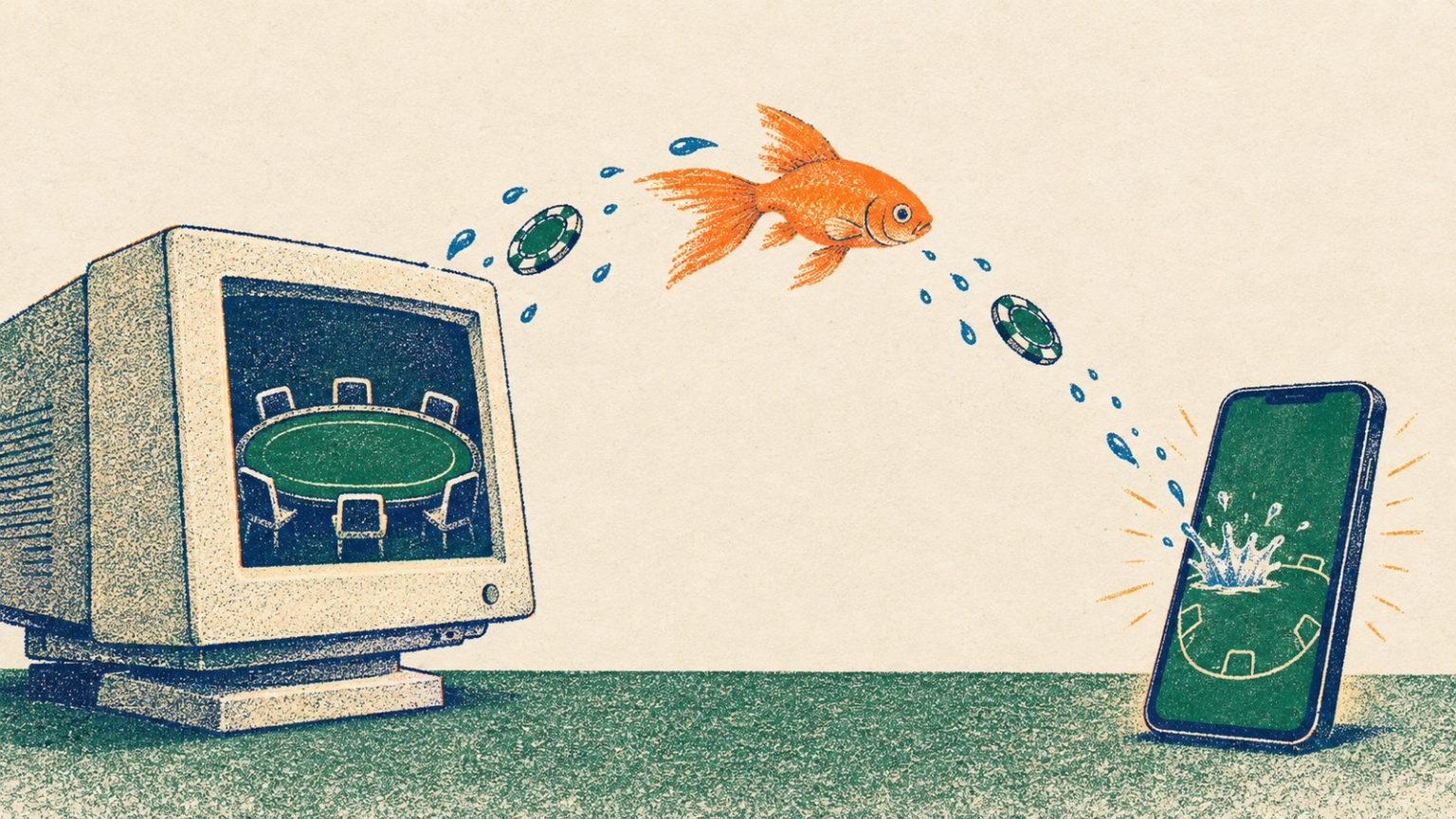
It wasn’t my imagination. The big online poker sites really did get harder. But the recreational players everyone misses didn’t vanish. They moved. And if you know where to look, the games are still out there.
How We Got Here
Key events from the past, that led to this state of the online poker industry.
The Boom Was Built on Bad Players
The poker boom that started in 2003, when an amateur named Chris Moneymaker qualified online and won the WSOP Main Event, brought millions of new players to the game. Most of them were terrible, in the best possible way. They played for fun, made obvious mistakes and didn’t mind losing.
That’s what made online poker profitable for everyone else. Poker is a game where good players win money from weaker ones. Without the weaker ones, there’s nothing to win.
Then the Study Tools Arrived
Over the next decade, studying poker became a serious discipline. Tracking software let players record every hand and analyse their opponents’ tendencies. Training sites taught thousands of people the same solid fundamentals. Then solvers arrived: programs that calculate close-to-perfect strategy for almost any spot.
Suddenly anyone willing to put in the hours could play near-perfect poker in standard situations. The average level at the tables went up year after year.
The Regulars Took Over
The result was a strange kind of ecosystem. On many big sites, a large share of tables are filled with regulars: players who study, play a lot of volume and know each other’s tendencies. Recreational players who sit down in those games lose fast, have a bad experience and often don’t come back.
Sites noticed. Many have moved toward anonymous tables, banned third-party tools and introduced more casual formats to protect recreational players. GGPoker went further than most in October 2026, banning third-party poker software entirely after a security scandal. It’s a sign of how seriously the industry takes the problem.
So Where Did the Fish Go?
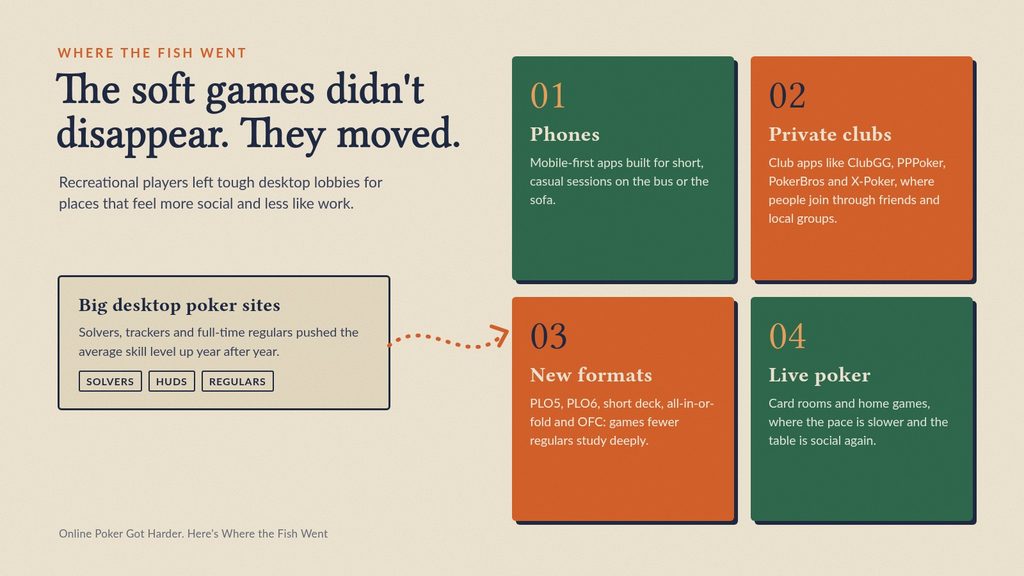
They didn’t quit. They found places that feel more fun and less like walking into a professional office.
To Their Phones
A whole generation of players never sat in front of a desktop poker client. They play on their phones, on the bus or on the sofa. Mobile-first apps built for short sessions and casual formats have drawn huge numbers of recreational players, many from countries where poker is booming now rather than fifteen years ago.
To Private Clubs
This is the biggest shift. Apps like ClubGG, PPPoker, PokerBros and X-Poker work differently from traditional poker sites. Instead of one big public lobby, action happens in private clubs, often grouped into unions that share tables and players.
These clubs tend to be social. People join through friends, local groups or community channels, and many play for entertainment rather than profit. The result is games that look a lot like 2006: loose preflop play, big multiway pots and players happy to gamble.
The catch is that clubs vary enormously. Some are well run, with fair rules, fast payouts and admins who take security seriously. Others aren’t. That’s where some knowledge, or a good guide, makes all the difference. When I went looking, I started with the oldest and most reputable poker agent platform. They keep a list of established clubs and unions across the major apps and explains the rake and rakeback terms before you join. It saved me from at least two clubs I’d otherwise have picked at random.
To Different Formats
Recreational players also drifted toward games that reward luck more and study less: Omaha variants like PLO5 and PLO6, short deck, all-in-or-fold and open-face Chinese. Fewer serious regulars study these games deeply, so the edges for a thoughtful player are often bigger.
To Live Poker
Live poker also gained from all this. Many players who got fed up with tough online games went back to casino card rooms and home games, where the pace is slower and the atmosphere is more social.
What This Means If You Want to Win
If you play online and feel like the games have dried up, the answer usually isn’t “study harder.” That helps, but against a table full of regulars your edge will always be thin. The bigger change is where you play.
A few practical takeaways:
- Judge the table, not the site. Before sitting down, look at how many players see each flop and how often they raise. Loose, passive tables are where the money is.
- Try formats regulars avoid. If you’re already decent at Hold’em, learning PLO5 or short deck can open up much softer games.
- Explore the private club world, but carefully. Start small, test withdrawals and choose clubs with a track record.
- Count the real costs. Rake and rakeback vary a lot between platforms and clubs. A soft game with heavy rake can still be a bad deal.
The Game Didn’t Die. It Moved.
Every few years someone declares that online poker is dead. It isn’t. It just doesn’t look like it did in 2006. The tough regulars stayed on the big sites. The recreational players, the ones who make poker fun and profitable, spread out to phones, private clubs, new formats and live games.
The players who still win online are the ones who noticed and followed them.
Online poker is just one example of how digital entertainment continues to evolve. From changing player habits to new gaming technologies, the online gaming landscape is constantly adapting. For more insights into digital trends and entertainment, explore the latest articles on CloudsMagazine.
FAQ
Why is online poker so much harder now?
Study tools, solvers and training content raised the average level of players, especially on big sites where regulars play a lot of volume.
Where are the softest online poker games?
Often in private clubs on mobile poker apps, in less-studied formats like PLO5 and short deck, and on recreation-focused platforms.
Is online poker dead?
No. Recreational players are still playing. Many have just moved from traditional desktop sites to mobile apps and private clubs.
Are private poker clubs safe?
It depends on the club. Choose clubs with a visible track record, start with small deposits and test a withdrawal before playing bigger.
