
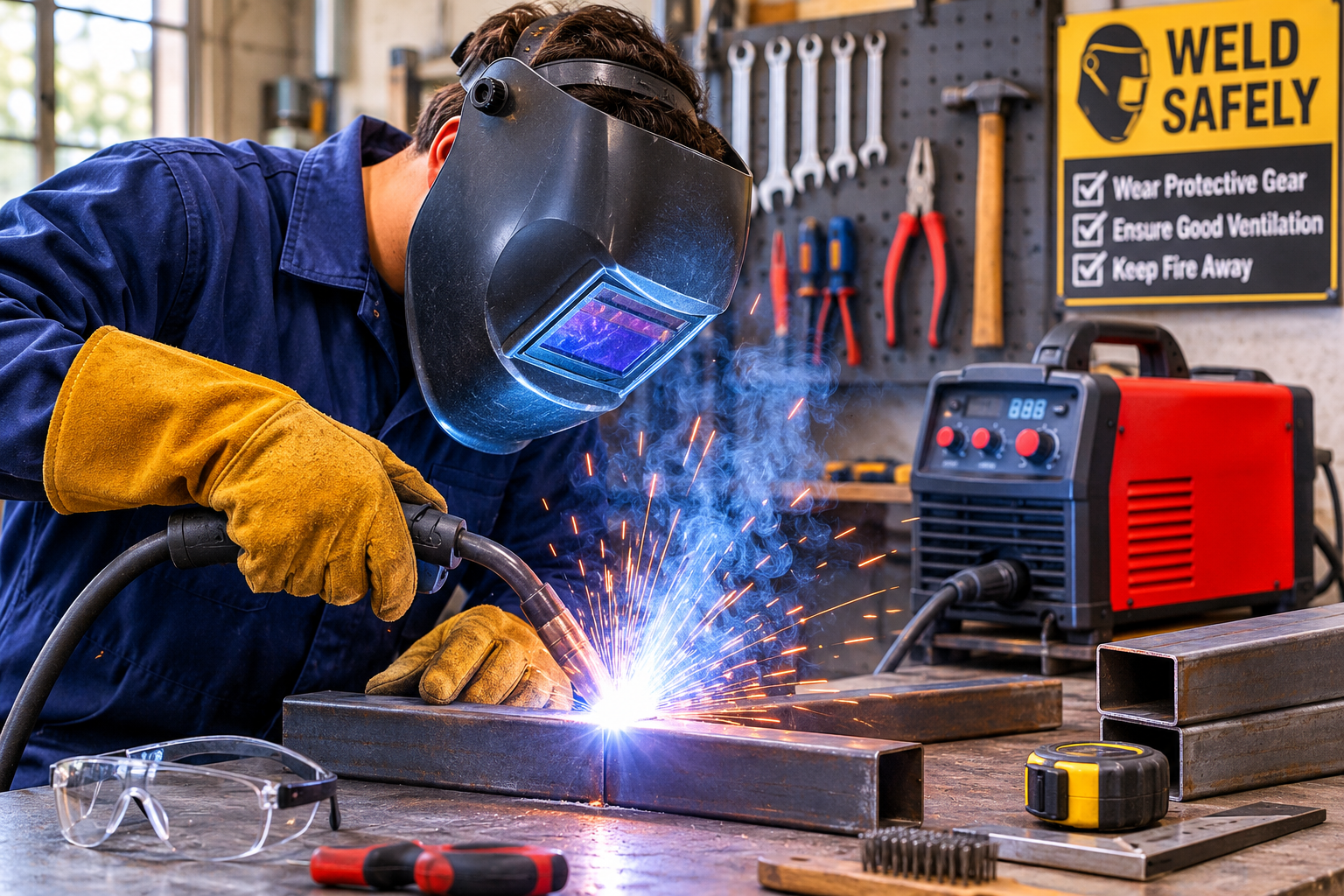
Welding is a valuable skill that opens the door to everything from household repairs and automotive restoration to custom furniture and metal fabrication. Before getting started, it’s worth understanding how different welding machines work and which materials and projects they are best suited for.
Some machines perform better on thin sheet metal, while others are designed for thicker materials or outdoor applications. However, producing strong, consistent welds requires more than just the right equipment. Technique, preparation, and regular practice matter just as much.
This guide covers the essential equipment, welding methods, safety precautions, and practical skills every beginner should know.
Key Takeaways:
- Different welding methods offer distinct advantages depending on the material, thickness, and working environment.
- Beginners should prioritize reliable equipment, proper protective gear, and a safe workspace.
- Joint preparation, heat control, and consistent welding technique contribute to weld quality.
- Practicing on scrap metal and gradually progressing to more complex projects helps develop practical welding skills.
Understanding the Fundamentals of Welding
Welding is a fabrication process that joins materials, primarily metals, using heat, pressure, or a combination of both. In common arc welding processes, an electrical arc generates enough heat to melt the base metal and form a joint.
Depending on the welding method, a filler material may be introduced to help create the connection. The molten metal then cools and solidifies.
Several factors influence the quality of a weld, including:
- Material type and thickness.
- Welding current and voltage.
- Joint design and surface preparation.
- Electrode or filler material selection.
- Welding angle and travel speed.
A weld that looks smooth on the surface isn’t necessarily strong. Poor fusion, inadequate penetration, and internal defects can compromise the joint without leaving obvious visual signs.
Choosing the Right Welding Method for Your Projects
The type of welding you learn first should depend on what you plan to build or repair. Someone interested in restoring classic cars has different equipment needs from someone repairing agricultural machinery.
Here are the four common arc welding methods and their applications.
| Welding Method | Best Suited For | Learning Difficulty |
| MIG welding | Automotive work, furniture, and general fabrication | Easy |
| TIG welding | Precision work, stainless steel, and aluminum | High |
| Stick welding | Outdoor repairs, farm equipment, and thick steel | Moderate |
| Flux-core welding | Outdoor fabrication and general steelwork | Easy to moderate |
MIG welding is a practical starting point for many beginners because its continuous wire-feed system simplifies electrode handling. TIG welding requires greater coordination but offers excellent control over the weld.
Stick and self-shielded flux-core welding are suitable for outdoor applications because they don’t rely on an external shielding gas that wind could disperse.
A multi-process welding machine may also be worth considering if you plan to experiment with multiple welding methods.
Essential Equipment for a Beginner Welder
Buying a welding machine is only part of setting up a functional workshop. You’ll also need protective equipment, metal preparation tools, and suitable welding accessories.
Personal Protective Equipment
Welding exposes you to intense light, extreme heat, sparks, and potentially harmful fumes. A basic protective equipment setup should include:
- A welding helmet with an appropriate filter shade.
- Heat-resistant welding gloves.
- Flame-resistant clothing.
- Safety glasses with side protection.
- Protective leather work boots.
- Suitable respiratory protection based on exposure risks.
An auto-darkening welding helmet can be particularly helpful for beginners because it allows them to see the workpiece before striking an arc.
Metal Preparation and Fabrication Tools
Preparing metal properly is just as important as the welding itself. Rust, paint, oil, and other contaminants can interfere with weld quality or create hazardous fumes.
An angle grinder, wire brush, welding clamps, measuring tape, metal square, and dedicated welding table are useful additions to a beginner’s workshop.
You don’t need to purchase every fabrication tool immediately. Start with the essentials and expand your collection as your projects become more demanding.
Setting Up a Safe Welding Workspace
A garage or backyard workshop can provide a suitable welding environment, provided it meets the necessary safety requirements.
According to the Occupational Safety and Health Administration (OSHA), welding hazards include metal fumes, ultraviolet radiation, electrical shock, burns, and fire.
Adequate ventilation and appropriate fume extraction are particularly important when working indoors. Opening a garage door alone may not provide sufficient protection from welding fumes.
Keep combustible materials away from the welding area, maintain a suitable fire extinguisher nearby, and use welding screens to protect other people from arc radiation.
Your electrical supply also needs attention. Check the machine’s input voltage, amperage requirements, and circuit compatibility before connecting it.
Never weld sealed containers, fuel tanks, or unidentified coated metals without appropriate professional assessment and safety procedures.
Developing Your Welding Skills
One of the most effective ways to learn welding is through supervised practice on clean scrap metal. This allows you to experiment without wasting expensive materials or compromising an important project.
Start by practicing straight weld beads on flat steel plates. Focus on maintaining consistent travel speed, controlling the welding angle, and observing the weld pool. Once you develop better control, you can progress to butt joints, lap joints, and T-joints.
As Mark Reynolds, founder of ToolCruiser.com, explains, “An expensive welding machine cannot compensate for poor technique. Beginners should spend more time understanding heat control, joint preparation, and travel speed. These fundamental skills will serve them well regardless of the equipment they use.”
Keeping a small welding journal can also help. Record your material thickness, machine settings, welding method, and results after each practice session. Over time, you’ll develop a useful reference for future projects.
Taking a hands-on welding course can further shorten the learning curve by helping you identify mistakes that may be difficult to recognize on your own.
Common Mistakes Beginner Welders Should Avoid
Many welding problems arise from preparation and technique rather than equipment limitations.
- Poor surface preparation: Welding over contaminated metal can introduce defects and affect the integrity of the joint.
- Incorrect heat settings: Excessive heat can cause burn-through and distortion, while insufficient heat may result in incomplete fusion.
- Inconsistent travel speed: Moving too quickly or too slowly can affect weld penetration, bead shape, and overall consistency.
- Ignoring the duty cycle: Welding machines have operating limits. Exceeding the manufacturer’s rated duty cycle can cause overheating and interrupt your work.
- Attempting complex projects too early: Vehicle frames, structural supports, lifting equipment, and other safety-critical applications require appropriate expertise and qualifications.
Learning to identify the cause of a welding defect is more valuable than repeatedly adjusting machine settings without understanding the underlying problem.
Final Words
Getting started with welding doesn’t require a professional workshop or the most expensive equipment on the market. A suitable welding machine, essential protective gear, a properly prepared workspace, and consistent practice provide a solid foundation.
Begin with simple, non-structural projects and gradually expand your skills as your confidence grows. Pay attention to how different materials respond to heat, learn from your mistakes, and resist the temptation to rush the process.
Good welding is a combination of knowledge, preparation, and technique. Developing those skills early can save considerable time, money, and frustration down the road.
