
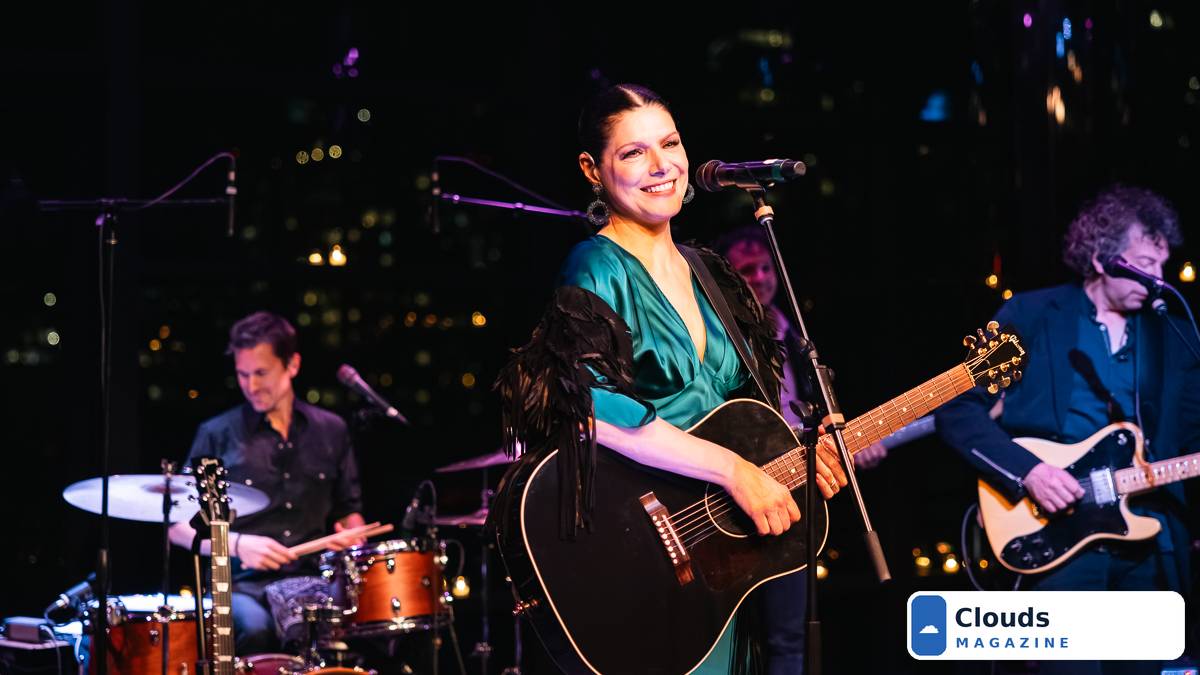
Veronica Stigeler is an American singer and songwriter who has performed for more than two decades under the stage name Queen V. Most people first meet her name beside a famous one: since 2014 she has been the wife of Bill Cowher, the Hall of Fame coach of the Pittsburgh Steelers.
Her own record is older than the marriage and runs on a separate track. Profiles of performers who built an independent career before a high-profile wedding, among them Emma Sugiyama, share that shape: years of work first, public attention second.
What follows is dated by the fixed points her career actually left behind: a debut EP in 2002, two studio albums, a three-part EP project, a film credit and a wedding in 2014. Where the record runs out, this profile says so.
Quick Answer
Quick Answer: Veronica Stigeler is a New York singer-songwriter who performs as Queen V. She released her debut EP, Critical, in 2002, the 2013 album The Decade of Queen V, its 2015 successor One More Time, and the Bridges EP trilogy. She married former Steelers coach Bill Cowher on May 24, 2014.
Who Is Veronica Stigeler?
Veronica Stigeler is a singer, songwriter and musician whose professional life has been spent in New York’s independent music world. She writes her own material, fronts her own band and performs under a stage name she chose long before fame by marriage arrived.
The wider public reached her from the other direction. Bill Cowher coached the Steelers for fifteen seasons, won a Super Bowl and moved to CBS, so his 2014 marriage drew the kind of attention her club career never had.
Reading her story in the right order matters. The music came first, by more than a decade, and it has continued on its own schedule ever since, with new releases and annual New York concerts that owe nothing to football.
Veronica Stigeler Quick Biography
The table below collects the fixed points of her biography, the details carried by her own professional record and by reliable coverage of her husband. One row is empty on purpose, and the reason is explained in the age section further down.
| Detail | Information |
|---|---|
| Full name | Veronica Stigeler |
| Professional name | Queen V |
| Also credited as | Veronica Stigeler-Cowher |
| Nationality | American |
| Birth date | Not publicly documented |
| Profession | Singer, songwriter, musician and actress |
| Music genres | Rock, hard rock, acoustic and singer-songwriter |
| Husband | Bill Cowher |
| Marriage date | May 24, 2014 |
| Children | No publicly confirmed biological children |
| Stepchildren | Meagan, Lauren and Lindsay Cowher |
| First release | Critical (EP, 2002) |
| Notable projects | The Decade of Queen V (2013), One More Time (2015), the Bridges trilogy |
| Notable screen appearance | A New York Christmas Wedding (2020) |
Two names run through everything she has released. Songs, concert films and screen credits appear under Queen V or under Stigeler-Cowher, but they belong to one continuous career that began in New York clubs at the start of the 2000s.
The table also shows the shape of the life. A working musician’s milestones fill most of the rows, while the marriage that made her searchable occupies exactly one line, which is roughly the proportion it holds in her career.
Early Life and Family Background
One honest fact shapes this section: no source of standing has ever published Veronica Stigeler’s birth date, her schooling or a sourced account of her childhood. Her early years are simply not part of the documented record, and this profile prints no invented version of them.
What is documented begins with her adult life in New York, where she was building a singing career by the early 2000s. The city is the fixed point: her venues, her band, her releases and her current home are all New York stories.
One family detail does come from her own mouth. On her official site she introduces her song “Write Your Song” as a tribute to her father, who served in the Korean War, and she returns to that tribute every Veterans Day.
How New York Influenced Her Artistic Journey
New York rewards performers who can hold a small room. Its club circuit runs on original material, tight bands and audiences who arrive knowing the difference, and it shaped the kind of artist she became: a writer first, a singer second.
Her early performance homes were the city’s working rock venues, among them CBGB and Don Hill’s, rooms that tested new acts nightly. Her official biography places her there at the start of the 2000s, learning the trade in front of paying crowds.
The city stayed central after the clubs. Her annual concerts now run at the Cutting Room and at Lincoln Center’s Kaplan Penthouse, and her website describes New York itself as a standing source of material for her songs.
Veronica Stigeler’s Music Career as Queen V
Music is the centre of her working life. The name on the recordings, the concert bills and the film credits is Queen V, and it predates her marriage by more than a decade, which is the single most useful fact in her biography.
The career divides into two broad sounds. She began in hard rock, fronting a band on electric stages, and gradually widened the act to take in acoustic guitar and piano, until the two sides could share one concert.
The NFL’s own magazine noticed the career on its own terms. The Playbook, the league’s publication, profiled Queen V in its “Her” issue, a detail worth pausing on: the football world covered her as a musician, not as an appendage.
Beginning Her Music Career
Her recorded career opens in 2002 with Critical, a debut EP that introduced Queen V as a rock singer with her own songs. An EP is a short first statement, and hers did the work a first statement should: it gave bookers and listeners something to judge.
The years after it were spent the way independent careers are built, in rehearsal rooms and on club stages. Her official biography recounts what that groundwork earned, and the milestones from it are concrete:
- Tours in 2003 opening for Billy Idol and for Twisted Sister
- A win in the WDHA Homegrown Spotlight Battle of the Bands in 2005
- Regular bills at New York rooms including CBGB and Don Hill’s
- A growing catalogue of original songs written for her own band
By the end of the decade she was an established fixture of her circuit rather than a newcomer, with a band, a repertoire and a name that bookers recognised. The albums that followed were built on that foundation.
Developing a Hard Rock Identity
The early Queen V sound was hard rock: electric guitars up front, a rhythm section built for volume, and a singer expected to cut through both. It is a demanding format, and it fixed her reputation as a powerful live vocalist.
Her biography places her in notable rock company during those years. A collaboration with Tom Morello arrived on her 2013 album, and her official biography also connects her with a song written alongside Lemmy Kilmister, the Motörhead frontman.
Those associations fit the world the early records came from. She was working the same circuit, in the same years, and the hard rock identity she built then still anchors one side of her concerts now.
Transition Toward Acoustic and Piano-Based Music
Around the middle of the 2010s her writing shifted weight toward piano and acoustic guitar. The change is audible across the Bridges project: the voice moves forward, the arrangements thin out, and the lyrics carry more of the load.
An acoustic arrangement is a stricter test of a song. With the volume gone, melody and words have nowhere to hide, and songs written for a rock band either survive the translation or expose themselves.
The shift widened what a Queen V concert could be, and it brought practical gains that show up across her later work:
- Songs that work in both full-band and unplugged arrangements
- Rooms of very different sizes playable on the same tour
- A clearer frame for personal, reflective lyrics
- Live recordings that document the songs rather than the production
- A second audience, drawn from the singer-songwriter world
Veronica Stigeler’s Albums and Music Projects
Her catalogue is compact and spread across twenty years: one EP at the start, two studio albums in the 2010s, and a three-part EP project that occupied her from 2016 to 2022. Each release marks a distinct stage of the career.
The list below is the spine of the discography, in the order the projects appeared:
- Critical (EP, 2002)
- The Decade of Queen V (2013)
- One More Time (2015)
- Bridges Vol. 1 (2016), Vol. 2 (2017) and Vol. 3 (2022)
- Bridges Live & Acoustic (2025)
Read as a sequence, the catalogue tells a plain story of persistence. There are no comeback narratives in it because there was never a departure: the releases arrive at working-musician intervals, each one extending the last.
Critical (2002)
Critical is where the public record of her career begins. Released in 2002, the EP presented Queen V as a hard rock singer performing her own material, and it gave the band a calling card for the touring that followed.
First releases matter out of proportion to their length because everything later is measured against them. The voice, the writing voice and the stage name all arrive here, fully formed enough that none of them ever needed replacing.
Critical also fixes the chronology that the rest of her biography depends on. Whatever else is uncertain in her record, the career was underway in 2002, twelve years before the wedding that introduced her name to sports fans.
The Decade of Queen V (2013)
Eleven years after the EP, her first full album took stock. The Decade of Queen V gathered the sound of her first ten years as a recording artist, and its title states its purpose plainly: a summing-up before the next phase.
The album also carries her best-known collaboration. Tom Morello, the Rage Against the Machine guitarist, worked with her on the record, a credit that places her club-circuit career in serious professional company.
A decade album is also a claim about survival. Most club acts of 2002 were gone by 2013; she marked the year with a full-length record instead, and treated the anniversary as a beginning rather than a memorial.
One More Time (2015)
One More Time, released in 2015, is her second studio album. It arrived a year into her marriage, at the point where a less settled artist might have let the career slow, and it shows no sign of that.
The record leans further into the reflective writing that the acoustic shift encouraged. Heard in sequence, the two albums divide her career neatly: the first looks back at the rock years, the second starts the quieter conversation.
Its timing deserves a line of its own. A second album, two years after the first and one year into a very public marriage, is evidence of a career being run on its own schedule, indifferent to the attention arriving from elsewhere.
The Bridges EP Trilogy (2016–2022)
The Bridges project is her most ambitious work: three EPs released across six years, in 2016, 2017 and 2022. The second volume was recorded in Nashville, and the third was made with Grammy-winning producer Chad Carlson.
A trilogy spread over that span becomes a diary whether the writer intends it or not. The songs track a life through marriage, a pandemic and a changed music business, and the bridge of the title reads as the link between those chapters.
The long gap before the third volume is part of the record too. The final EP appeared in 2022, closing a project that had stayed open through the strangest years of her career, and closing it on her own timetable.
Bridges Live & Acoustic
In March 2025 the Bridges material was revisited on Bridges Live & Acoustic, a live album of nine recordings from a New York performance. It documents the acoustic format that her concerts had settled into.
Live albums serve a different purpose from studio ones. This one preserves the room, the band and the arrangements as audiences actually hear them, and it stands as the most current full-length statement of her career.
It also closes a loop. The Bridges songs began as studio EPs; hearing them stripped down, in front of an audience, completes the journey from the rock clubs to the listening rooms that her concerts now alternate between.
Popular Songs by Veronica Stigeler
Across the albums and EPs, a handful of songs carry her reputation. They are the tracks her concerts return to, the ones her website reaches for when it needs a single song to stand for a season or a cause.
Six of them map the range of the catalogue, from the rock years to the acoustic present. Each one also marks a working method: a song built for a full band, a song built for a film, a song built for a cause.

Technicolor
“Technicolor” is the song her later career keeps circling back to. It lends its name to a filmed concert at the Atlantic, and it represents the bright, full-band side of her writing.
The title suits the role. In a catalogue with plenty of shadow in it, “Technicolor” is the widescreen number, built for a stage with the whole band behind her.
It is also the song she chose to represent the live act on film, which is its own kind of verdict. Artists title concert films after the number they trust to explain them to strangers.
Alone
“Alone” belongs to the pandemic chapter. Filming its video in the autumn of 2020 was, by her own account on her website, the first project she was able to take on with a team once work resumed, at a distance.
The song then travelled: it gave its name to a 2021 screen project in which she is credited as actress, writer and producer. Few of her songs have lived in as many formats.
Her website returns to the shoot each October, which has turned the song into a seasonal marker for her audience. The autumn imagery of the video, all turning leaves and low light, is now part of the song’s identity.
Honest
“Honest” is one of the catalogue’s singer-songwriter centrepieces, a song whose title announces its method. Her writing generally avoids decoration, and this is the track listeners point to when they describe that plainness as a virtue.
It sits in the middle period of the catalogue, where the rock arrangements were loosening and the words were moving to the front of the mix.
Songs like this explain why her audience stayed through the style change. The subject matter never moved: it was always her own life, examined closely, and the quieter arrangements simply made that easier to hear.
Strong
“Strong” was released as a single in 2020 and has become her most public-facing song. She used a scene from its video on her website to urge followers to vote on Election Day, which tells you the work she expects the song to do.
Resilience is the theme, and the timing of its release, in the first year of the pandemic, fixed its meaning for the audience that found it then.
The song has since become the one she lends to public moments. When she wanted a single image to carry a civic message to her followers, she reached for a frame from its video rather than a photograph of herself.
Like You Do
“Like You Do” is the catalogue’s love song, carried in her acoustic sets where its lyric can land at close range. Songs like this are why the piano-and-guitar format mattered: the arrangement leaves the sentiment unprotected.
It is also a reminder that the personal songs predate the public marriage. She was writing about attachment, in her own name, long before anyone connected her private life to a famous one.
In the acoustic sets the song does quiet work between louder numbers. A catalogue needs those hinges, and hers has survived every rearrangement of the set list, which suggests the band trusts it as much as she does.
Write Your Song
“Write Your Song” is the most personal recording she has released. On her official site she introduces it directly: her father served in the Korean War, and the song is her tribute to him.
She returns to it every Veterans Day, which has made it a fixed point in her calendar as much as in her catalogue. It is the one song where the private citizen and the performer are fully visible at the same time.
Personal material of that kind is a risk for a private person. That she keeps performing it, annually and on the record, says more about her relationship with her audience than any interview could.
Veronica Stigeler’s Songwriting and Creative Collaborations
The credits matter because they separate a songwriter from a singer of other people’s songs. Veronica Stigeler writes her own material, and the writing is the constant across every change of style, band and format in her career.
Writing for herself means the catalogue reads as one long document. The father tribute, the resilience single and the love song all come from the same hand, which is why listeners describe the records as chapters rather than products.
Collaboration enters at the level of craft. A songwriter working alone controls everything and risks repeating herself; a good collaborator interrupts habits. Her credits show both modes at work:
- Solo writing across the early rock catalogue
- A recorded collaboration with guitarist Tom Morello
- A song written alongside Lemmy Kilmister, per her official biography
- Production work with Chad Carlson on the third Bridges volume
- Co-writing and producing roles on her screen projects
- Arranging her own songs for the acoustic live format
Veronica Stigeler’s Acting Career
Music is the main road, but her credits include screen work as well. She is listed as an actress in a television film and as actress, writer and producer on music-led productions that grew out of her own catalogue.
The screen work follows the music rather than competing with it. Each credit is tied to a song, a concert or her stage name, which keeps the acting a branch of the Queen V project instead of a second career.
That pattern is worth naming because it is unusual. Most musicians who act chase the second career; her credits read as extensions of the first one, made by the same small team, under the same name.
A New York Christmas Wedding (2020)
Her clearest acting credit is the 2020 television film A New York Christmas Wedding, where she plays Dr. Patricia Boyle. She is credited in the production as Veronica Stigeler Cowher, under her married name.
A holiday romance is a long way from a rock club, and that is the point of interest. The role shows a performer willing to be a beginner in a second medium, in public, two decades into a career in another one.
The credit also matters for the record itself. It is one of the few places her married name appears in a formal cast list, which is why the film is cited so often in accounts of her life.
Alone (2021)
Alone, released in 2021, grew directly out of her song of the same name. She is credited on the production as actress, writer and producer, three roles that together amount to authorship of the whole piece.
The project began with the song’s video, filmed among autumn trees in October 2020 with a small, distanced crew. It stands as the clearest example of her songs generating their own screen life.
It is also a document of its moment. A production assembled under pandemic restrictions, outdoors, with a skeleton team, shows the working method of her whole later career: small scale, personally controlled, finished anyway.

Queen V Fall Ball, Live at the Cutting Room (2022)
The Fall Ball is her annual autumn concert at the Cutting Room, one of Manhattan’s best-known listening rooms. A filmed performance from the series was released in 2022, preserving the full-band format at its most polished.
The Cutting Room connection runs through her whole later career. The room suits the mixed format she settled into: loud enough for the rock material, quiet enough for the piano songs.
Her own site carries photographs from the November 2021 edition of the Ball, guitar in hand under stage lights. The annual rhythm matters: the Fall Ball is to her calendar what the Spring Fling is to May, a fixed point audiences plan around.
Queen V’s Technicolor Live at the Atlantic (2023)
A second filmed concert followed in 2023, released as Technicolor Live at the Atlantic, again with her involvement extending beyond the performance itself. It takes its title from her song “Technicolor.”
Taken together, the concert films do the work that a major-label machinery would do for a bigger artist. They fix the live act on record, in her own name, under her own control.
For a researcher they have a second use: they are dated, verifiable evidence of the career’s later years, the kind of primary material her biography is otherwise short of. The work documents itself, even when the life does not.
Who Is Bill Cowher?
Bill Cowher is the reason her name travels so far beyond music audiences. Born on May 8, 1957, in Crafton, Pennsylvania, he played linebacker in the NFL before becoming one of the most recognisable coaches of his era.
He took over the Pittsburgh Steelers in 1992 and stayed for fifteen seasons, winning eight division titles and reaching two Super Bowls. The second of those ended in victory: Super Bowl XL, in February 2006, when the Steelers beat Seattle 21–10.
He retired from coaching after the 2006 season and joined CBS’s The NFL Today, where he remains a studio analyst. In 2020 he was inducted into the Pro Football Hall of Fame, and in 2021 he published an autobiography, Heart and Steel.
Veronica Stigeler and Bill Cowher’s Marriage
Veronica Stigeler became Bill Cowher’s wife on May 24, 2014. The date is one of the firmest fixed points in her biography: it is carried consistently across coverage of the couple and fits the timeline of Cowher’s own public record.
The marriage joined two settled, separate careers. He was seven years retired from coaching and established at CBS; she was a year past her first album and working on her second. Neither career paused for the wedding.
Rolling Stone profiled Cowher’s new life the following year, in 2015, and the marriage was part of that picture. In 2018 the couple’s base shifted: Cowher put his Raleigh house up for sale and announced a full-time move to New York, her city and her career’s home ground.
How Their Different Careers Connect
A coach and a club singer look like opposites until the working patterns are compared. Both careers are built on live performance in front of paying audiences, on preparation nobody sees, and on reviews written by strangers.
Both also run on seasons. His year bent toward autumn Sundays; hers bends toward autumn concerts, including the Fall Ball she plays each year and the album she released one March after a New York performance.
The practical overlap is simpler: each understands a household where work happens at night, in public, and cannot be repeated if it goes wrong. That shared understanding is the most plausible reading of a marriage that has stayed notably free of publicity.
Bill Cowher’s First Marriage and Family History
Before Veronica, Bill Cowher was married to Kaye Cowher, née Young. The two had met as students at North Carolina State, and Kaye had her own sporting career, playing professional basketball for the New York Stars alongside her twin sister.
Kaye died of skin cancer on July 23, 2010, aged 54. The Associated Press carried the news at the time, and Cowher’s later public life, including his autobiography, treats her loss as the defining event of his middle years.
The couple had three daughters: Meagan, Lauren and Lindsay. All three played college basketball, Meagan and Lauren at Princeton and Lindsay at Wofford and Elon. Veronica’s marriage in 2014 made her their stepmother, a role handled in the next section.
Does Veronica Stigeler Have Children?
No reliable source records any biological child of Veronica Stigeler’s, and she has never announced one. The accurate statement is the narrow one: she has no publicly confirmed children of her own.
Through her marriage she became stepmother to Cowher’s three daughters, who were adults or near it when she joined the family:
- Meagan Cowher, who played basketball at Princeton and married former NHL player Kevin Westgarth
- Lauren Cowher, who also played basketball at Princeton
- Lindsay Cowher, who played at Wofford and Elon and married former NBA player Ryan Kelly in August 2014
Stepmotherhood in a family formed by loss deserves plain handling. The daughters’ mother died in 2010; Veronica arrived four years later, into a family with its own history, and the family’s public record keeps the details of those relationships private.
Veronica Stigeler’s Age and Birthday
This is the section readers arrive for, and it has to begin with the honest answer: Veronica Stigeler’s birth date has never been published by any source of standing. She has no encyclopaedia entry of her own, and no reputable coverage of her career or her wedding states her age.
What circulates instead is a single exact date, February 23, 1974, repeated across dozens of biography websites, always with the same confidence and never with a source. New York City is usually attached to it as her birthplace, with the same absence of evidence.
This profile does not print that date as fact, and it does not print her age. Her adult status has never been in question — a recording career from 2002 and a marriage in 2014 settle that — but a birthday is a fact, and facts need better support than repetition.
The Birth Date That Isn’t: How an Invented Detail Spread
The February 23 date fails every test a genuine fact passes. No interview gives it, no record office extract supports it, and the outlets that covered her wedding, her husband’s Hall of Fame induction and her own releases have never printed it.
The careful end of the biography circuit concedes as much in its own wording, calling the date “reported” and noting that her age is given differently on different sites. A fact that its own carriers hedge is not a fact; it is a rumour with good distribution.
The same circuit attaches a birthplace and even a middle name to her with equal confidence and equal absence of sourcing. This profile leaves both unprinted for the same reason: nothing checkable stands behind either of them.
Two Years, One Birthday
The copiers cannot even keep their invention consistent. Most print February 23, 1974; at least one prints February 23, 1972 — the same day and month with a different year, which is the signature of a date copied carelessly rather than checked.
The arithmetic built on the date collapses the same way. Pages that print 1974 have described her as 52 years old in a year when their own date would make her younger, an error no source working from a real record would survive.
Details travel with the date and give the game away further. The birthplace paired with it is asserted, never evidenced, and the versions disagree with each other in the small print while agreeing in the headline, which is copying behaviour, not reporting.
Repetition Is Not a Record
When a hundred pages agree on a detail that none of them sourced, the agreement measures copying, not truth. Her birthday is the clearest example in her whole record, which is why this profile examines it rather than repeating it.
Profiles built the same way, among them Ann Fleischer, show the pattern from the inside: a small set of firm dates, a long documented quiet, and a clear line where the verified record ends. Her record is thinner than most, which makes the discipline more important, not less.
The practical rule for readers is simple. A date that appears only on pages selling biographies, and nowhere in the coverage written while events were happening, should be treated as decoration. Her career offers plenty of real dates to build on instead.
What Is Veronica Stigeler’s Net Worth?
Veronica Stigeler’s net worth is not publicly established. No financial record, verified earnings history or statement from her supports any figure, and the totals attached to her name on biography websites are unsourced estimates that no two of them agree on.
Her income, like any independent musician’s, is assembled from several streams rather than a salary:
- Recordings, streaming and song royalties
- Songwriting and publishing income
- Live performances and annual concerts
- Screen credits as actress, writer and producer
- Filmed concerts and live albums
- Merchandise and direct sales through her own site
One distinction matters here. Her husband’s earnings from fifteen seasons of coaching and nearly two decades of television are his professional record, not hers, and folding them into her name produces a number that describes neither of them accurately.
Veronica Stigeler’s Life Away From the Spotlight
Her public presence runs through her work and almost nothing else. She keeps a website for the music, posts about shows, songs and veterans’ causes, and lets the private remainder of her life stay private.
The one public cause she returns to is personal. Her father’s Korean War service stands behind “Write Your Song,” and her Veterans Day tributes to him are the most personal statements she makes in public.
Spouses of very famous men who keep the same bargain appear throughout this site’s profiles; Kate Connelly built a television career of her own and still kept her private life out of the frame. Stigeler’s version is stricter: no memoir, no reality television, no monetised marriage.
What Makes Veronica Stigeler’s Story Interesting?
Her biography connects two worlds that rarely share a dinner table: independent rock music and professional football. Five features of the record explain why the searches keep coming.
None of the five depends on the missing details. Her story is interesting for what is documented, which is the standard this profile has tried to hold from the first paragraph.
1. She Developed an Independent Artistic Identity
Queen V existed for twelve years before the marriage that made her searchable. The stage name, the band, the catalogue and the club reputation were all built without any connection to football, and they remain the substance of her public life.
That independence is measurable. Count the releases, tours and films dated before 2014 and the ones after it: the career’s centre of gravity never moved, even as the audience for it multiplied.
2. She Has Explored Different Musical Styles
Hard rock, acoustic balladry and piano-led writing all sit in one catalogue, and her concerts now move between them in a single evening. Few independent artists sustain two formats for twenty years; she built a second one rather than abandoning the first.
The Bridges project is where the two sounds meet on record. Its later live album strips the songs back in public, which amounts to a demonstration that the writing, not the volume, was the point all along.
3. She Has Worked in Different Creative Roles
Singer, songwriter, bandleader, actress, writer, producer: her credits cross the whole production line of her own projects. On the screen work she is not hired talent but an author, which is the same position she occupies in her music.
That breadth is a survival strategy as much as an artistic one. An independent career lasts by controlling its own means of production, and her credits show her doing exactly that, project after project.
4. Her Music Includes Personal Themes
The catalogue keeps returning to her own life: a father who went to war, endurance through a pandemic, attachment and loss. Songs like hers give listeners documented fact about their writer’s inner life, offered deliberately, in her own words and timing.
That deliberateness is the dividing line in her biography. What she has chosen to publish, in songs, is vivid and specific. What she has not chosen to publish stays unpublished, and the contrast is the most honest summary of her available.
5. She Maintains a Private Personal Life
The most unusual feature of her story may be what is missing from it. Like Heini Wathén, she married one of the most recognisable men in his field and then declined, completely and permanently, to convert the marriage into a public career of its own.
Privacy on that scale is an achievement, not an accident. It has held through a Hall of Fame induction, a bestselling autobiography by her husband and a decade of searchable curiosity about her name.
Veronica Stigeler at a Glance
The table below holds only the fixed points of her biography, the events and credits a checkable source confirms. Anything carried only by unsourced websites has been left out on purpose, including every version of her birthday.
| Detail | Information |
|---|---|
| Full name | Veronica Stigeler |
| Stage name | Queen V |
| First release | Critical, a debut EP in 2002 |
| First album | The Decade of Queen V (2013) |
| Second album | One More Time (2015) |
| Long-form project | The Bridges EP trilogy (2016–2022) |
| Live album | Bridges Live & Acoustic (2025) |
| Screen credit | Dr. Patricia Boyle in A New York Christmas Wedding (2020) |
| Marriage | Bill Cowher, May 24, 2014 |
| Home base | New York City |
| Birth date | Not publicly documented |
| Net worth | Not publicly established |
Read the two empty rows in that table as information rather than failure. A biography of firm lines, each of them true, serves a reader better than a longer one padded with details nobody ever verified.
The timeline those lines make is still a full career: a debut in 2002, albums in 2013 and 2015, a trilogy finished in 2022, a film role, a wedding and a live album in 2025. Nothing in it needs an invented birthday to hold together.
Frequently Asked Questions About Veronica Stigeler
The questions below are the ones readers bring to this name most often. Each answer keeps to the documented record, and says plainly where that record runs out.
Several of them circle the same gap, her missing birth date, and each gets the same honest answer rather than a dressed-up guess.
1. Who is Veronica Stigeler?
Veronica Stigeler is an American singer and songwriter who performs as Queen V. She has released music since 2002 and, since May 24, 2014, has been married to Bill Cowher, the former Pittsburgh Steelers head coach and CBS analyst.
Her career is based in New York, where she still plays annual concerts under the Queen V name.
2. What is Veronica Stigeler’s stage name?
Her stage name is Queen V. It has been attached to her recordings, concerts and screen credits since the start of her career, more than a decade before her marriage brought her name to sports audiences.
3. How old is Veronica Stigeler?
Her age is not publicly documented. No source of standing has ever published her birth date; the exact date repeated on biography websites is unsourced, and one site prints a different year for it. This profile therefore prints no age for her.
4. When did Veronica Stigeler marry Bill Cowher?
The marriage dates to May 24, 2014. Cowher had retired from coaching in 2007 and was working as a CBS studio analyst; she was between her first and second studio albums as Queen V.
The couple later settled in New York full-time, after Cowher put his Raleigh house up for sale in 2018.
5. What does Veronica Stigeler do for a living?
She is a working musician: a singer, songwriter and bandleader who releases records, plays annual New York concerts and has added acting, writing and producing credits on screen projects drawn from her own music.
6. What are Veronica Stigeler’s most popular songs?
The songs most associated with Queen V include “Write Your Song,” her tribute to her father, alongside “Technicolor,” “Strong,” “Alone,” “Honest” and “Like You Do.” Together they cover the full range of her writing, from full-band rock to solo acoustic pieces.
7. Does Veronica Stigeler have children?
No biological child of hers has ever been publicly confirmed. Through the marriage she is stepmother to Bill Cowher’s three daughters, Meagan, Lauren and Lindsay, whose mother, Kaye Cowher, died in 2010.
8. What is Veronica Stigeler’s net worth?
It is not publicly known. No verified financial record supports any figure, and the estimates printed on biography websites are unsourced and inconsistent with one another. Her husband’s coaching and television earnings are a separate record.
What can honestly be described is the shape of her income: twenty-plus years of releases, concerts and screen credits, sold largely through her own channels.
9. Is Veronica Stigeler an actress?
Yes, on a small scale. She plays Dr. Patricia Boyle in the 2020 television film A New York Christmas Wedding, credited as Veronica Stigeler Cowher, and she holds acting, writing and producing credits on Alone and her filmed concerts.
10. Is Veronica Stigeler still involved in music?
Yes. She released the live album Bridges Live & Acoustic in 2025, plays an annual Spring Fling concert at Lincoln Center’s Kaplan Penthouse and a Fall Ball at the Cutting Room, and continues to write and record new songs.
Her official website lists new material and further New York dates in preparation, so the catalogue is still growing.
Conclusion
Veronica Stigeler’s story is two stories that happen to share a surname’s second half. One is a New York musician’s: an EP in 2002, tours, two albums, a three-part project about bridges, and concerts she still plays every spring and autumn.
The other is a marriage that began on May 24, 2014, and brought her name to an audience of football fans who had never heard her sing. The marriage is real and documented; so is everything the music record shows, and neither half needs the other to be interesting.
Readers who want the public half of the football story can follow it through the reference biography of Bill Cowher, where the coaching career that made her name searchable is set out in full. Her own record, told at its true length, stands complete as it is.
