
Introduction
Software bugs can cause many problems, from small display errors to failed payments and unexpected system crashes. Finding the cause of these issues takes time, especially when a project contains many files, features, and connected services. This is why developers use debugging methods and bug-tracking tools to identify problems and manage fixes. If you are searching for How Does Endbugflow Software Work, it is important to understand both the general debugging process and the information available about Endbugflow itself.
Endbugflow is a name associated online with discussions about software debugging and workflow management. However, publicly available information does not clearly confirm all its product features, technical design, or official operating requirements. This guide explains how a structured debugging workflow works, which features may be relevant, how teams can benefit from it, and what you should verify before using Endbugflow. It also covers security, practical examples, and alternative tools to help you make an informed decision.
What Is Endbugflow Software?
Endbugflow is a software related name that appears in online discussions about debugging and development workflows. The name may suggest a focus on handling software bugs and improving the process of resolving them. However, the exact identity and capabilities of a dedicated Endbugflow product should be confirmed through reliable documentation before making specific claims about its operation.
To understand the topic, it helps to distinguish between a debugging workflow and a bug-tracking application. A debugging workflow is the series of steps developers follow to find, investigate, fix, and test a software problem. A bug-tracking application is a tool used to record issues, assign tasks, track progress, and document solutions. Some development platforms combine these functions, while others require separate tools.A well-organized process is important because software problems can come from many sources. An error may result from a coding mistake, an incorrect setting, an outdated dependency, or a problem with an external service. Without a clear process, developers may repeat the same tests, lose important information, or fix a symptom without addressing the real cause.
The Main Purpose of Endbugflow
If Endbugflow is being considered for debugging or workflow management, its intended value would need to be assessed by looking at how it handles problem reports, technical information, issue organization, and resolution tracking. These are common goals of software development workflows, but they should not automatically be treated as confirmed Endbugflow features.
Who May Benefit From This Type of Software?
Developers may use debugging tools to investigate errors and test code changes. Quality assurance testers can report problems and check whether fixes work correctly. Project managers can use issue records to understand progress and assign responsibility. Businesses that maintain websites, mobile applications, or online services can also benefit from a reliable process for handling technical problems.The right solution depends on the team’s size, technical skills, budget, and security requirements.
How Does Endbugflow Software Work?
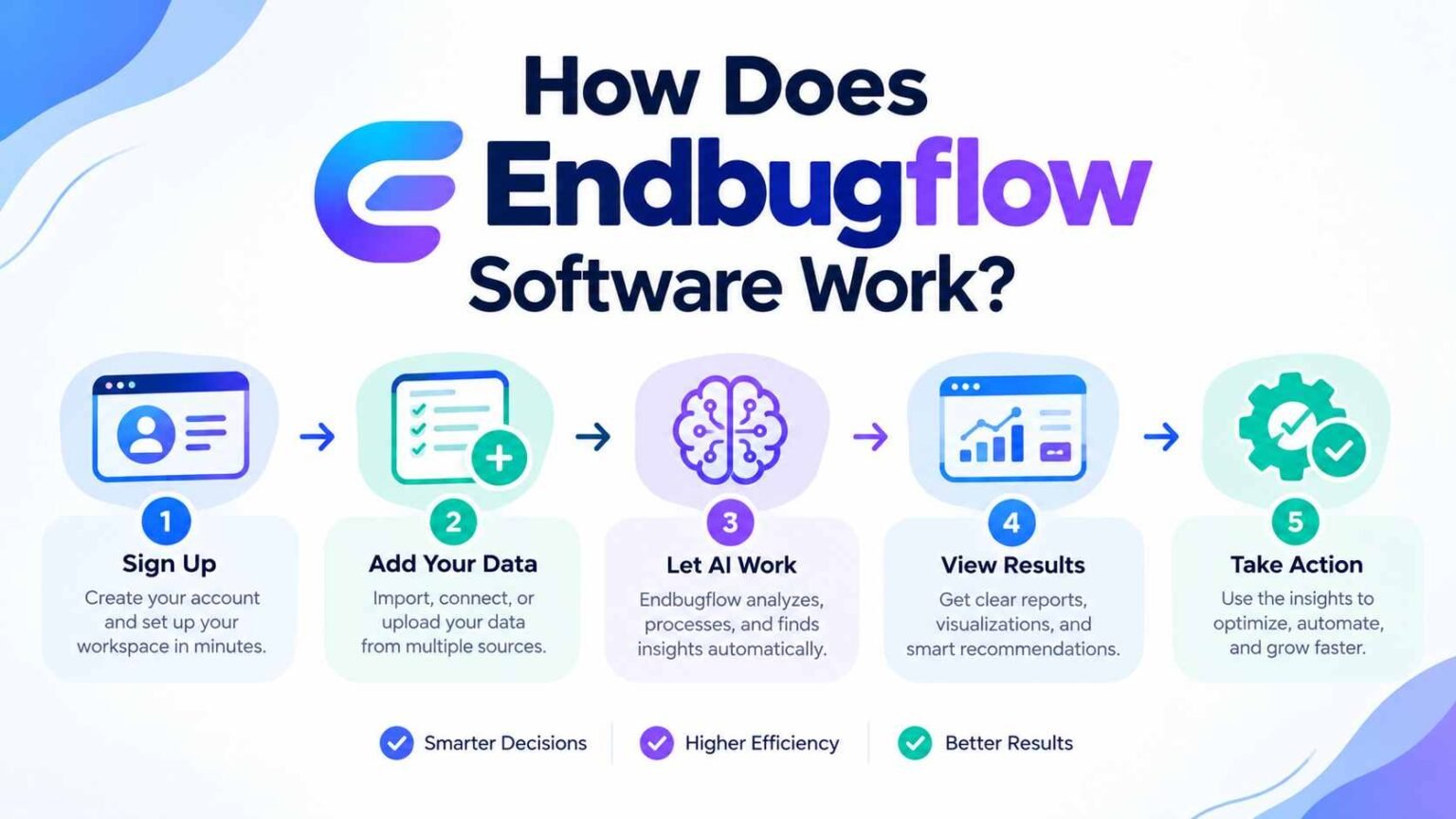
The answer to How Does Endbugflow Software Work depends on the specific product and its verified features. In general, a software debugging workflow begins when someone identifies an error. The team then collects information about the problem, investigates its cause, develops a fix, and tests the result. If the issue is resolved, the team records the outcome and continues monitoring the application.
For example, suppose a website stops displaying a customer’s order history. A developer needs to determine whether the problem comes from the website code, the database, a network request, or the user’s account. Error messages and application logs can provide useful clues. The developer can then reproduce the issue, inspect the relevant code, and test a possible solution.A dedicated tool may support some of these activities by organizing reports or connecting technical information with issue records. However, the exact functions available in Endbugflow have not been established through reliable product documentation. It would therefore be inaccurate to claim that the software automatically detects every bug, uses artificial intelligence, or performs all debugging tasks without human involvement.
The Basic Endbugflow Workflow
A typical debugging workflow follows a clear sequence. First, a problem is detected through user feedback, testing, or application monitoring. Next, the team collects details such as the error message, time of failure, and steps needed to reproduce it. The issue is then recorded and prioritized according to its impact.Developers investigate the cause, prepare a fix, and test the change. Finally, the team confirms that the original problem has been resolved and checks that the fix has not created another issue. This process provides a useful framework for understanding the work associated with software debugging, even when a particular product’s internal design remains uncertain.
Key Features Associated With Endbugflow Software
When evaluating Endbugflow, it is useful to examine the features that matter in a modern debugging workflow. These include error reporting, technical logs, issue management, collaboration, and monitoring. They can help explain what to look for in the product’s official documentation, but they should not be described as confirmed features without supporting evidence.
Bug Detection and Error Reporting
Bug detection means identifying behavior that does not match what a program should do. A problem may appear during manual testing, automated testing, or normal use. For example, a form may refuse to submit valid information, or a mobile application may close unexpectedly.Error reporting turns the problem into useful information. A clear report should explain what happened, what the user expected, and how the problem can be reproduced. Screenshots, error messages, and relevant system details may also help. Good reports reduce confusion and allow developers to investigate the issue more efficiently.
Error Logs and Technical Context
Logs record events that occur while software is running. Depending on the application, they may contain timestamps, error messages, request details, or information about failed operations. A stack trace can show the sequence of function calls associated with an error, helping a developer locate the part of the program that needs attention.This information is most useful when it includes enough context to reproduce the problem. However, logs may also contain private information, authentication details, or customer data. Teams should remove sensitive information and limit access to authorized people.
Issue Prioritization and Management
Not every bug requires immediate attention. A spelling mistake on an internal page has a different impact from a payment failure affecting many customers. Issue management helps teams consider severity, urgency, frequency, and user impact when deciding what to fix first.A structured record can also identify who is responsible for investigating the problem and whether a solution is being tested. Before relying on Endbugflow for these tasks, check whether its actual interface and documentation support the required functions.
Team Collaboration and Notifications
Developers, testers, and project managers often need to share information about the same problem. Clear issue records help everyone understand what has happened, which steps have already been tried, and what needs to happen next. Notifications can also help team members respond when an issue changes status or requires attention.Whether Endbugflow provides built-in collaboration or notification features remains something to verify.
Monitoring and Workflow Automation
Monitoring helps teams observe application behavior after a release. It may reveal repeated errors, unusual response times, or failures affecting particular users. Automation can reduce manual work by creating reports, running tests or notifying a team when a defined condition occurs.These capabilities are common in modern development environments, but their availability in Endbugflow should not be assumed without official technical evidence.
How Does Endbugflow Software Work Step by Step?
Understanding the debugging process is easier when each stage is explained separately. Although Endbugflow’s exact technical workflow is not confirmed, the following steps describe how a typical software debugging system operates.
Step 1: Identify a Software Error
The process starts when a user, tester, or monitoring system notices unexpected behavior. A website may load slowly, an application may crash, or a feature may produce the wrong result. The team records the problem and determines whether it can be reproduced.
Step 2: Collect Error Details
The next step is to gather useful evidence. Developers may review logs, screenshots, error messages, browser details, and the steps that caused the problem. Accurate information makes it easier to understand the conditions under which the error occurs.
Step 3: Organize and Prioritize the Issue
The problem is recorded so that the team can track its progress. Developers consider how many users are affected and whether the issue blocks an important function. Serious failures usually receive attention before minor visual problems.
Step 4: Investigate the Root Cause
Developers examine the relevant code, recent changes, configuration settings, and system responses. They may reproduce the error in a test environment and run additional checks. The aim is to identify the underlying cause rather than simply hide the visible problem.
Step 5: Develop and Test a Fix
After identifying the cause, the developer changes the code or configuration. The proposed fix should be reviewed and tested before release. Regression testing is also important because a change that solves one problem might affect another feature.
Step 6: Verify the Result and Monitor Again
The team confirms that the original problem no longer occurs under the same conditions. After deployment, monitoring and user feedback can help reveal whether the problem returns. The issue can then be closed with a record of the solution.
A Practical Example of How Endbugflow Software Works
Imagine that an online store allows customers to add products to their shopping carts, but the checkout page displays an error when customers try to pay. This situation provides a simple example of how a structured debugging workflow can help.First, a tester reports the checkout failure and records the steps needed to reproduce it. The development team checks the error message and relevant application logs. The evidence suggests that the checkout service is receiving an unexpected response from a payment-related component.
The developer then examines recent code changes and tests the checkout process in a controlled environment. After finding the cause, the developer prepares a correction and asks the testing team to check different payment scenarios. The team confirms that successful payments work correctly and that invalid payment details still produce appropriate messages.
Finally, the correction is released, and the team monitors the checkout process for further errors.This is an illustrative example of a standard debugging process, not a verified demonstration of Endbugflow software. Its actual involvement in any of these steps would depend on the product’s confirmed capabilities.
Benefits of Using a Structured Debugging Workflow
A structured debugging process can make software maintenance more organized. When developers follow the same basic steps for reporting, investigating, and resolving issues, they are less likely to overlook important details. Clear reports also reduce the need to ask users repeatedly for information about a problem.Another benefit is better communication. Testers can provide reproduction steps, developers can document their findings, and managers can track progress. This shared understanding is especially useful when several people work on the same application.
A consistent process can also help teams identify recurring errors. If similar problems appear repeatedly, developers can look for a common cause and make a broader improvement rather than applying separate temporary fixes.However, these benefits do not depend on a single product name. A team can achieve many of them through good development practices and suitable tools. The actual value of Endbugflow would depend on its verified functions, ease of use, reliability, and fit with the team’s existing workflow.
Endbugflow Software vs. Traditional Bug Tracking
Debugging and bug tracking are closely related, but they serve different purposes. Debugging focuses on finding the cause of a problem and correcting it. Bug tracking focuses on recording issues, assigning responsibility, and following each issue through to resolution.
Some teams use spreadsheets or shared documents to record bugs. This can work for small projects, but it becomes harder to manage when many issues are reported. Dedicated issue trackers provide more organized records and may support labels, assignments, status updates, and notifications.
Debugging tools serve another role. They help developers inspect code, examine program behavior, and understand errors. Error-monitoring services can collect information about failures that occur in live applications. Larger teams may connect several types of tools to create a more complete workflow.
| Approach | Main purpose | Best suited for |
| Manual tracking | Record issues and progress | Small projects |
| Bug-tracking software | Organize and assign issues | Development teams |
| Debugging tools | Investigate code and errors | Developers and testers |
| Error monitoring | Observe failures in running applications | Live websites and services |
| Integrated workflow | Connect reporting, tracking, and investigation | Teams with more complex needs |
Endbugflow should be compared with these approaches only after its actual features have been verified. The best option is the one that solves the team’s real problems without adding unnecessary complexity.
Is Endbugflow Software Safe and Reliable?
The safety of Endbugflow cannot be established from its name or general descriptions alone. Before installing unfamiliar software, identify its official publisher and obtain it from a trustworthy source. Check whether the publisher provides clear installation instructions, product documentation, support information, and a history of updates.Permissions deserve particular attention. A debugging application may request access to source code, repositories, application logs, or other technical information. Give it only the permissions it needs. Avoid sharing passwords, access tokens, customer records, or other confidential information in reports.
If the software is unfamiliar, test it in an isolated environment rather than connecting it immediately to a production system. Security software can help scan downloaded files, but a clean scan alone does not prove that an application is trustworthy.Reliability also requires evidence. Look for documented limitations, independent user experiences, and a clear process for reporting problems. Until credible product information is available, it is better to describe Endbugflow’s safety and reliability as unverified than to make a definite claim.
Limitations and Things to Verify Before Using Endbugflow
One important limitation is the lack of clearly established public information about Endbugflow’s exact technical capabilities. Without reliable documentation, users cannot confidently determine which features are included, how the product processes data, or which systems it supports.Start by confirming the product’s identity and official website. Review its installation requirements, supported operating systems, licensing terms, and pricing. If integrations are advertised, check whether they work with your existing development tools.
You should also look for release notes, update history, security policies, and support options. If the product claims to offer automatic debugging or artificial intelligence, seek a technical explanation or a practical demonstration rather than relying only on promotional statements.Finally, consider whether the software solves a problem your team actually faces. A complicated tool may create more work than it removes. Test any suitable product with a small project first and assess its usefulness before depending on it for important systems.
Alternatives to Endbugflow Software
If Endbugflow’s identity or capabilities remain unclear, several established tools can help with different parts of the development process.GitHub Issues and Jira are examples of tools used to organize work and track reported problems. Visual Studio Code and browser developer tools help developers inspect code and investigate errors. Sentry is an example of an error-monitoring platform that can help teams understand failures in running applications.
These tools are not direct equivalents in every situation. An issue tracker does not replace a debugger, and a monitoring service does not automatically manage every stage of a software project. Teams may combine them according to their needs.
Before choosing an alternative, consider cost, ease of use, integration options, data protection, and the technical skills available within your team. Review current documentation and pricing because features and plans can change. Most importantly, select a tool based on verified capabilities rather than assuming that a lesser-known product offers the same functions.
Frequently Asked Questions
1. How Does Endbugflow Software Work in Simple Terms?
A typical debugging workflow identifies a software problem, collects evidence, investigates its cause, applies a fix, and tests the result. Endbugflow’s exact implementation of this process has not been independently confirmed.
2. Can Endbugflow Automatically Detect Software Bugs?
Automatic detection is possible in some development and monitoring tools. However, there is not enough verified information to confirm whether Endbugflow offers this feature. Check its official documentation before relying on automated detection.
3. Does Endbugflow Use Artificial Intelligence?
Its use of artificial intelligence has not been established through reliable product documentation. Do not assume that it can generate fixes, explain errors automatically, or identify root causes without evidence.
4. Can Beginners Use Endbugflow Software?
Beginners can learn debugging by following clear steps and using tools with helpful documentation. Whether Endbugflow is suitable for beginners depends on its interface, setup requirements, learning resources, and available support.
5. What Should You Check Before Installing Endbugflow?
Verify the publisher, official download source, system requirements, permissions, privacy policy, update history, and licensing terms. Test unfamiliar software safely before granting it access to important projects or confidential information.
Conclusion
Understanding How Does Endbugflow Software Work starts with learning how software bugs are reported, investigated, corrected, and tested. A structured debugging workflow helps teams organize problems, share technical information and reduce the risk of repeated errors. However, the exact features, security, and technical design of Endbugflow remain unverified without reliable product documentation. Before using it, confirm its identity, review its requirements, and check its security practices. Compare it with established debugging and issue-tracking tools to see which option meets your needs. Choosing software based on clear evidence, practical testing, and genuine project requirements is the safest way to improve your development workflow.
