
In the winter of 1651 the Crown of Scotland, the sceptre and the sword of state, the regalia with which Scottish kings had been crowned for a hundred and fifty years, were inside Dunnottar Castle, on its rock above the North Sea south of Stonehaven, and Oliver Cromwell’s army was outside.
Cromwell had already destroyed the English crown jewels, melted down for coin. He wanted the Scottish ones for the same fate. The Honours of Scotland had been used at Scone that January to crown the young Charles II, and when his army marched south to defeat at Worcester they had been sent for safety to the strongest castle in the north-east, the seat of the Earls Marischal, the Keiths, who had been hereditary keepers of the regalia since the Middle Ages. The Earl himself was a prisoner in the Tower of London. His castle was held by a garrison of about seventy men under a governor named George Ogilvy. The Keiths’ own cloth, the dark Keith tartan, came to them later and by a roundabout road, but it carries their name.
The English arrived in the autumn. By the spring of 1652 they had brought up heavy guns, and it was clear that Dunnottar would fall.
The minister’s wife
The Honours got out before it did, and the woman who carried them was called Christian Fletcher. She was the wife of James Grainger, minister of the little parish of Kinneff, five miles down the coast, and she had, it seems, a talent for talking her way through an English cordon.
Her own account, given years later when she asked the restored King for a reward, is that she obtained leave from the English commander to visit the governor’s wife inside the castle, and came out with the crown in her lap, hidden under her clothes, and the sceptre and sword wrapped in bundles of flax carried by her servant, who passed for a woman going home with her spinning. The English soldiers let her through. The commander, by some accounts, helped her onto her horse.
She and her husband buried the Honours under the floor of Kinneff church, beneath the pulpit and the pew, and dug them up every few months at night to air them, so that they should not rust. There they stayed for eight years, until Charles II came back in 1660 and they were returned to Edinburgh Castle. Dunnottar surrendered in May 1652. The English searched it from top to bottom and found nothing.
The Honours had one more disappearance in them. After the Union of 1707 they were locked in a chest in Edinburgh Castle and forgotten, and for a century Scots believed they had been quietly taken to London. In 1818 Sir Walter Scott, who believed otherwise, obtained a royal warrant to open the chest. The crown, the sceptre and the sword were inside, wrapped in linen, exactly as they had been left. They have been on public view in the castle ever since, and they are the oldest set of royal regalia in the British Isles, because the English ones were melted. Christian Fletcher was voted two thousand merks by Parliament in 1664, and it is not recorded that she was ever paid in full.
There is another version, told on the cliffs, in which the regalia were lowered by rope down the seaward face of the rock to a serving girl gathering seaweed on the shore, who carried them away in her creel. It may be that both things are true, at different times. The minister’s wife is the version in the records.
The Marischals
The Keiths had held Dunnottar since the fourteenth century, and they had held their office for longer. The Great Marischal of Scotland was the King’s officer responsible for the safety of his person in Parliament and for the custody of the regalia, and it had been hereditary in the family since the days of Bruce, whose cavalry at Bannockburn was commanded by Sir Robert Keith. In 1458 they were made Earls Marischal. In 1593 the fifth Earl founded Marischal College in Aberdeen, which is still there, and is the second largest granite building in the world.
They lost everything in 1715. The tenth Earl Marischal, George Keith, came out for the Jacobites, was forfeited, and spent the rest of a long life in exile as the friend and ambassador of Frederick the Great of Prussia. His brother James became a Prussian field marshal and died at the head of Frederick’s army at Hochkirch in 1758. Dunnottar was sold and stripped. It is a magnificent ruin now, on its rock, with the sea on three sides and the path down and up again from the car park, which is steep, and which every visitor remembers.
The clan’s motto is Veritas vincit, truth conquers. Its crest is a stag’s head. Its chief today is the Earl of Kintore. Children of the name can wear it too, and a girls kilt in the dark green and blue is one of the nicer ways to bring a nine-year-old to Dunnottar.
A tartan by inheritance
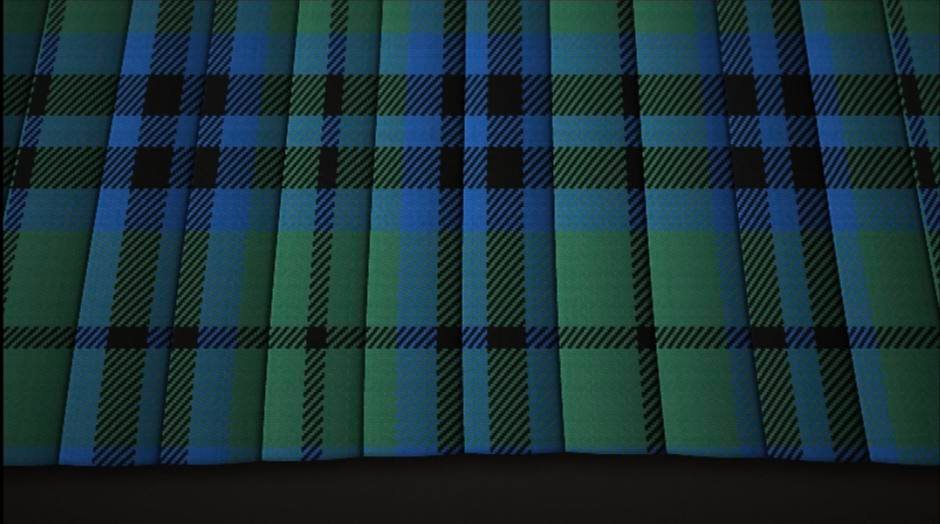
The Keith tartan came to the family, fittingly, through the office. The archives record that the sett is the same as that of the Falconers, and derives from the Lord Falconer who took over the entailed lands of the Keith Earls Marischal in the early 1800s. There is a family called Keith-Falconer who wear it. It is also the tartan of the Austins and the Marshalls, and it appears in Wilsons of Bannockburn’s pattern book of 1819 under the name Austin, with the earliest record of it as Keith in 1838.
It is a dark, well-mannered tartan in the Government family: broad bands of weathered green and black with a strong blue through them, without a thread of red or yellow. Retailers offer Keith tartan made to order as kilts, skirts, sashes and scarves, or by the yard, in Modern and Ancient colours, and Keiths, Austins, Falconers and Marshalls may all wear it. A separate tartan was designed in 2003 for the town of Keith in Moray, which has nothing to do with the Marischals and everything to do with a weaving mill.
Stonehaven, a Saturday in April
Laura Keith is thirty-six and grew up in Stonehaven, which means she grew up with Dunnottar at the end of the cliff path and the story of the crown in the minister’s wife’s lap told to her by every teacher she ever had. Her daughter Isla is nine. Isla has recently been told the same story, at the same school, and has taken it personally.
This Saturday they are walking out to the castle, as Laura did at Isla’s age, and Isla has asked to go in the kilt.
The kilt is new. It is a kilted skirt in the Keith tartan, and Laura ordered it from Scottish Kilt after an afternoon of failing to find one in a shop that fitted a nine-year-old with a long back and no waist to speak of. The outfitter’s girls kilt page says, in a sentence Laura found unusually honest, that its girls’ clothing is cut to her own measurements, since age sizing is an average rather than a fit. There are kilted skirts in any tartan, sashes with bows, and party dresses trimmed in a family sett, all made to a measured waist and length.
Isla’s waist was measured where the skirt would sit, and the length to just above her knee, standing straight, with a book on her head. It came in two weeks, blue and green with the black through it, the pleats stitched down to the hip, and a small sash in the same cloth with a bow, which she has worn to school twice already over her uniform, against regulations.
Today she wears the kilt with a white polo shirt, a fleece, thick socks and boots, because the path down to the castle is steep and the wind off the sea is the wind off the sea. Laura wears a scarf in the same tartan and a great deal of Gore-Tex.
At the top of the rock, in the ruined keep, Isla asks the question she has been saving.
“Where did she hide it? The crown.”
“Under her dress. In her lap, on her horse. And the sword and the sceptre in bundles of flax, so the soldiers thought it was washing.”
“And they let her past?”
“They let her past. The English officer helped her onto her horse.”
Isla looks down at her kilt, and at the blue and green, and out at the sea, and considers this in silence for some time.
“If it was me,” she says at last, “I’d have put it under my kilt. There’s more room.”
Truth conquers
The Earls Marischal kept the regalia of Scotland for three hundred years and lost their castle, their title and their country for a prince who never came back. But the Honours survived, because a minister’s wife with a talent for lying to soldiers walked out of Dunnottar with them and buried them under her husband’s pulpit.
The Keith tartan is blue and green and black, and it came to the family by the same road as their castle, through the office and the land. It looks well on a nine-year-old on the top of the rock in an April wind, with the North Sea below her, working out where she would have hidden the crown.
