
A little after midnight in the middle of May 1743, more than a hundred soldiers gathered quietly on a common north of London, checked their muskets, and started walking to Scotland.
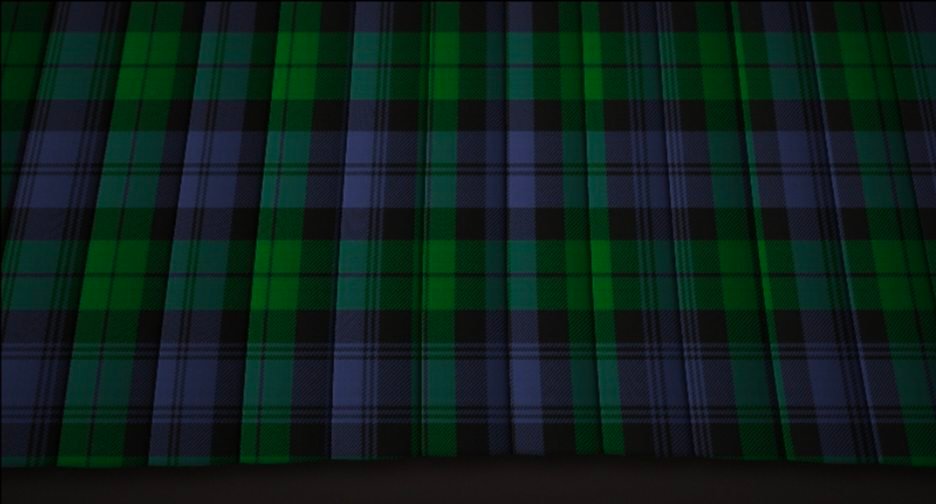
They had about four hundred miles to cover. They did not know the country, most of them spoke Gaelic and very little English, and they were dressed in a way that made hiding difficult: twelve yards of dark tartan belted round the body and thrown over the shoulder, bare knees, blue bonnets. They moved at night and lay up in woods by day. For four days the most powerful government in Europe had no idea where they were. The cloth they wore was the army’s dark government sett, the pattern known today as the Black Watch tartan.
This is the story of those men and of the cloth they were wearing, which has outlived them, their regiment and the empire they served, and which is today one of the most widely worn tartans on earth.
A promise
The men belonged to the Highland Regiment, newly formed and not yet famous. Eighteen years earlier, in 1725, General George Wade had raised six Independent Companies to keep order in the glens after the Jacobite rising of 1715. He recruited them from clans the government trusted: three companies of Campbells, one each of Frasers, Grants and Munros. Their work was to watch the passes, stop cattle raiding and enforce the law that had disarmed the Highlands.
It was good service and men of good family competed for it. A Highlander in the Watch could legally carry a sword and pistols when his neighbours could not. Many privates were the sons of gentlemen, and it was said that some rode to muster with a servant behind them to carry their kit. In Gaelic they were called Am Freiceadan Dubh, the Black Watch. The usual explanation is the look of them. The regular army wore scarlet, and Gaelic speakers called them the red soldiers. The Watch wore a plaid of dark blue, dark green and black, and beside the redcoats they looked like shadows.
In 1739 the companies were increased to ten and formed into a regiment of the line. It mustered for the first time the following spring in a field beside the River Tay at Aberfeldy. The men understood, because they had been told so when they enlisted, that their service was for the Highlands. They were a watch, and a watch stays at home.
In March 1743 the regiment was ordered to march to London. The reason given was that King George II wished to see his Highland soldiers for himself. Scotland’s senior judge, Duncan Forbes of Culloden, warned the government in writing that the men would see it as a breach of faith. He was ignored.
The road north
They reached London in May. The King was not there. He had already left for the Continent, where Britain was at war with France. The regiment was reviewed instead by old General Wade, and Londoners turned out in crowds to stare at the strangers in their plaids. Then came new orders: to Gravesend, and ships for Flanders.
Rumour did the rest. A story went round the ranks that Flanders was a lie as well, and that the real destination was the West Indies, where regiments went to die of fever. Men who had been tricked once were ready to believe they were being tricked again.
So they left. Two corporals, the kinsmen Malcolm and Samuel MacPherson, and a private named Farquhar Shaw emerged as leaders. They took their arms, harmed nobody and stole nothing. They simply turned round and walked north, the way they had come.
They got as far as Northamptonshire. On 22 May, in a wood outside the small town of Oundle, they found themselves surrounded by cavalry. There was a parley. The Highlanders offered to surrender in return for a pardon. None was promised, but they were exhausted and outnumbered, and they laid down their arms in hope. They were marched back to London and locked in the Tower.
A court martial condemned them all. The sentence was carried out on three. On the morning of 18 July 1743, the two MacPhersons and Farquhar Shaw were shot by a firing squad inside the Tower of London while their comrades were made to watch. Some two hundred others were broken up and scattered to garrisons in Jamaica, Gibraltar and Minorca. The remainder were shipped to Flanders after all.
Two years later, at Fontenoy, that same regiment fought its first battle. The day went badly for the allied army, and the Highlanders were among the troops who covered the retreat, charging repeatedly to hold the French off. It was the start of a reputation that would run through Ticonderoga, the Peninsula, Waterloo, the Crimea and two world wars. The name the Gaels had given them became official in time, and the regiment carried it until 2006, when it became a battalion of the Royal Regiment of Scotland.
The cloth that outlived them
Through all of that, one thing did not change. The dark plaid the deserters wore on the road to Oundle is the same pattern a piper wears today. It is also a natural first choice for a kilt, because a cloth that belongs to no clan can be worn by anyone.
Its proper name is the Government sett, and the archives of the Scottish Tartans Authority record it as the tartan appointed for the Highland Companies in 1725 and carried into the regiment in 1739. Very few tartans can claim a date like that. Most clan patterns cannot be traced beyond the early 1800s.
It is a plain design, and that is its strength. Broad bands of navy and bottle green, divided by black, with fine black lines running in pairs through the blue. There is no bright stripe anywhere. From a distance it reads as a single dark field, and only as you come close does the pattern appear.
After 1746, when Highland dress was outlawed for civilian men in Scotland, soldiers were the great exception, and for thirty-six years this was the tartan most Highlanders could legally wear. The weavers who supplied the army, William Wilson & Sons of Bannockburn, took to adding a coloured line to tell one regiment from another. A yellow line produced what is now called Gordon. White and red produced MacKenzie. Campbell, Sutherland, Grant Hunting and Munro Hunting are the same cloth or close cousins. A large part of the clan tartan system grew out of that one dark plaid.
And because it began as the uniform of men from four different clans, it has never belonged to any family. Black Watch tartan is what writers on Highland dress call a universal sett. Anyone may wear it. No surname is required and nobody will ask for one. Today it is woven in the near-black Modern colours, in softer Ancient shades where the blue lifts towards sky, in Weathered browns and greys, and in Dress versions with white, and it is made into everything from full kilts to scarves, ties and sashes.
A Tuesday evening, somewhere
Picture a different man, in a different century. He is forty, or sixty. He lives in Ohio, or Ontario, or Queensland. His daughter is getting married in the autumn and has asked, a little shyly, whether he would think about wearing a kilt, because her grandmother was a Scot and it would mean something.
He has no idea where to start. His surname is German. He does not know if he is allowed.
What he finds, after an evening of reading, is that there is a tartan with no gatekeeper, and that it happens to be the most dignified one in the book. Navy, green and black will sit under a black jacket at the reception and beside a tweed one at the rehearsal dinner. It will suit him whatever his colouring. It will not clash with the bridesmaids. When the groom’s friends decide they want to match, it will be the one tartan they can all wear without anyone pretending to a family they do not have.
He also discovers that a kilt is not bought like a pair of trousers. It sits at the navel, inches above where his jeans sit, and it hangs to the middle of the kneecap. Three measurements matter: the waist at that height, the hips at their widest, and the drop from waist to knee, which is easiest to find by kneeling on the floor and measuring to the ground. Rack sizes get at least one of those wrong for nearly everyone, which is why he ends up ordering a kilt cut to his own numbers from a workshop that makes every piece to order. He chooses eight yards, because it is a wedding and he wants the weight and the swing. If it had been for the Highland games he would have taken five, lighter and cooler.
He is asked one last question, whether he would like it pleated to the sett, so the pattern runs unbroken round the back, or to the stripe, in the military way. He reads that the Black Watch showed the blue in their pleats, where the Argyll and Sutherland Highlanders, in a lighter version of the same cloth, showed the green. He picks the blue.
On the day he fastens the straps, settles the sporran a hand’s width below his belt, pushes the kilt pin through the front apron only, the way the instructions told him, and looks in the mirror. He does not look like a man in fancy dress. He looks like a man in a very old uniform that has been given to everybody.
What they were walking towards
The three men shot in the Tower have never been forgotten in the Highlands, and every history of the regiment begins with them. It is a story about a promise that was not kept and about people who wanted nothing more dramatic than to go home.
They did not get there. The cloth did. It went home to Scotland and then out again across the world, on the backs of soldiers first and then of anyone who cared to wear it. There is some justice in that. A hundred men once tried to carry that dark plaid north through the English night and were stopped in a wood in Northamptonshire. Nobody has been able to stop it since.
